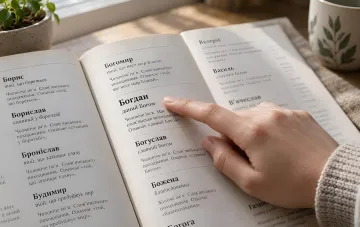
Solomiya is a name that is hard to confuse with any other. It sounds gentle, yet it carries a distinctive character and a long history. Today it is more than just a traditional Ukrainian name: according to the Ministry of Justice of Ukraine, in the first half of 2026 Solomiya entered the top ten most popular female names among newborns. Alongside it, the top list included Sofia, Zlata, Milana, Emilia, Anna, Anastasia, Polina, Maria, and Eva. The name gained particular visibility in western Ukraine: the Lviv Interregional Department of the Ministry of Justice reported that in Lviv Oblast Solomiya became the second most popular female name after Sofia, and in Rivne Oblast it also ranked among the most common female names.
Ancient Hebrew Roots and Meaning
The name Solomiya has ancient Hebrew origins. In the reference dictionary "Vlasni imena liudei" (Personal Names of People), compiled by Larysa Skrypnyk and Nyna Dyatkovska at the Institute of Linguistics named after A. A. Potebny of the National Academy of Sciences of Ukraine, it is presented together with the variant Salomeya and is associated with the meaning "peace." It is precisely this symbolic interpretation — peace, calm, harmony — that most often appears in popular descriptions of the name and shapes its emotional tone in the eyes of modern parents.
Solomiya in the Ukrainian Naming Tradition
The name has long been firmly established in the Ukrainian naming tradition. In the aforementioned NAS of Ukraine dictionary, Solomiya is listed among the personal names used in Ukraine, and among the notable bearers, the outstanding Ukrainian singer Solomiya Krushelnytska is singled out — one of the brightest figures of world opera in the early twentieth century. Thus, the name has not remained solely a part of historical tradition but has actively returned to modern use, while retaining its cultural depth and recognizability.
Character and Traits Attributed to Solomiya
In traditional characterizations, Solomiya is described as a girl with a calm outward manner but a strong inner core. She may not constantly seek to be the center of attention, yet she holds her own opinion and is reluctant to give it up under pressure. Among the positive traits are independence, responsibility, sincerity, and persistence; Solomiyas are said to have the ability to see things through and to protect the people who are truly close to them. At the same time, the characterizations also note a less pleasant side: stubbornness, sensitivity to criticism, and a tendency to dwell on situations that others quickly forget. In communication, Solomiyas are often described as selective — easy to keep acquaintances, but truly trusting only a narrow circle. In love, the name is traditionally associated with a need for stability, trust, and sincerity: for close relationships, feeling emotional safety and respect is important, and manipulation is not tolerated. A creative component is also highlighted: good taste, a love of music, art, and beautiful things, and the possibility of realizing oneself in creative professions. To emphasize: this refers specifically to traditional and popular interpretations, not to a scientifically established link between a person's character and their name.
Forms of the Name and Name Day
For the name Solomiya there are many tender forms: Solya, Solka, Solomiyka, Solomiyechka, Solyunya, Solyushka, Mia. The most familiar in everyday speech remain Solya and Solomiyka. According to the new church calendar, Solomiya's name day falls on August 3 — on this day the Orthodox Church of Ukraine honors the righteous Solomiya the Myronoissa (myrrh-bearer). However, as we will show below, the name day date may differ depending on confessional affiliation.
Contradictory Data
Sources record a discrepancy in the date of Solomiya's name day. According to the new church calendar of the Orthodox Church of Ukraine, the name day is celebrated on August 3 (the righteous Solomiya the Myrrh-bearer). Meanwhile, in the calendar of the Ukrainian Greek Catholic Church, August 1 mentions Solomiya — the mother of the seven Maccabean martyrs. Thus, bearers of the name may celebrate their name day on one of two dates — August 1 or August 3 — in accordance with their confession. This is not a data error but a consequence of differences in the liturgical calendars of the two churches; however, for a reader unfamiliar with this nuance, the information may look like a mismatch. We provide both dates so that the reader can orient themselves independently.