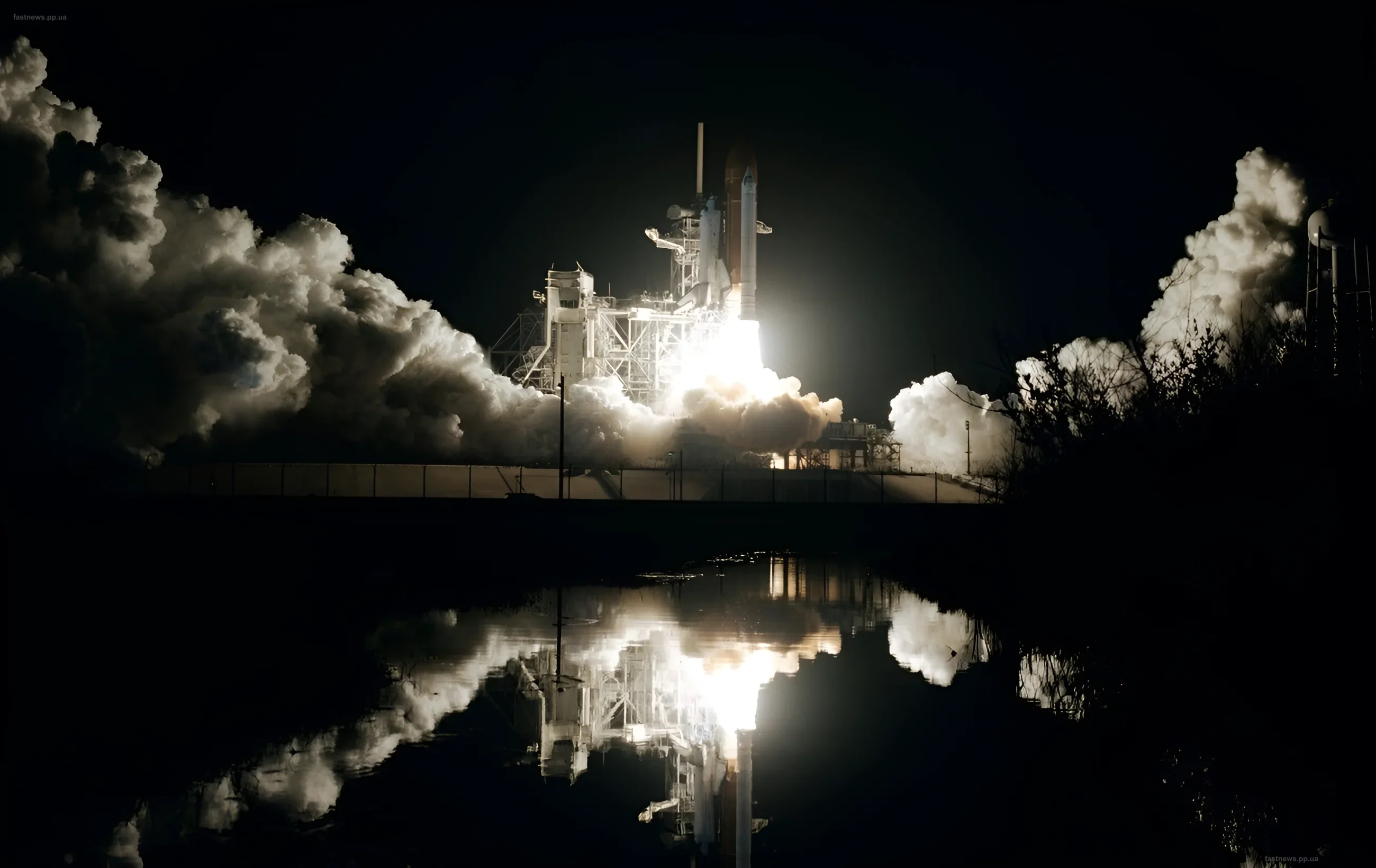
In August 2025, the Moon will witness another collision with space debris. This time, an expended upper stage of SpaceX's Falcon 9 rocket will impact the lunar surface. According to astronomers' calculations, the object will reach the surface at hypersonic speed — more than seven times the speed of sound.
Who and how the threat was detected
The trajectory of the impending impact was identified by renowned astronomer Bill Gray using specialized software. His data was confirmed by the U.S. Space Force's cataloging system. The stage that became the "projectile" remained after a launch that took place on January 15, 2025.
At that time, Falcon 9 delivered two private lunar landers to orbit: the Blue Ghost Mission 1 lander from Firefly Aerospace, which successfully landed, and the Japanese Hakuto-R Mission 2 module from ispace, which ended its mission with an unsuccessful crash.
What will happen upon impact
Currently, the expended stage is moving at a speed of about 8,700 km/h. Upon collision with the Moon's surface, the kinetic energy will be so great that the metal will completely vaporize. Only a fresh crater and scattered rocks will remain at the impact site.
This is not the first such case. In March 2022, a stage of China's Chang'e-5 T1 rocket similarly crashed into the Moon.
The future problem: space junk and lunar bases
A single Falcon 9 impact does not pose a direct threat, but it vividly illustrates a growing problem. NASA is actively preparing to deploy a permanent residential base on the Moon's south pole. The intensity of launches in this direction will rapidly increase.
If government agencies and private companies do not implement the practice of controlled deorbiting of stages, uncontrolled debris will create a direct threat to the life support of future lunar settlements and astronauts.
Monitoring and risks
Currently, NASA carefully monitors space debris only around Earth to protect the International Space Station (ISS), which regularly performs evasion maneuvers. In the future, the U.S. Space Force will have to expand the monitoring zone to cover all space between Earth and the Moon.
The situation with traffic in low Earth orbit has sharply deteriorated due to the deployment of large commercial satellite constellations. In particular, SpaceX has already crossed the 10,000 active Starlink satellites mark this year. Due to such density, there are more accidental micro-collisions of working spacecraft with remnants of old rockets, creating thousands of new small fragments that are difficult to track.
Search for solutions and threat to Earth
Scientists are already developing theoretical concepts for cleaning space using giant nets, electromagnets, or harpoons, but none of them have been implemented in practice yet.
Meanwhile, uncontrolled debris threatens not only space but also Earth. For example, on January 17, 2025, a large unknown fragment (likely part of an Indian rocket) fell directly on a village in Kenya. For safe disposal of spent spacecraft, international agencies usually use the uninhabited area in the south Pacific Ocean, known as "Point Nemo." However, thousands of uncontrolled objects still remain in orbit and can enter our planet's atmosphere at any moment.


