
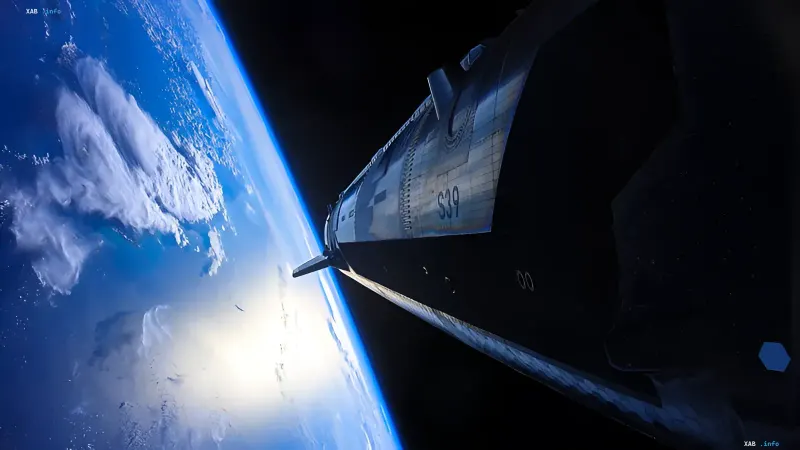
SpaceX has received official approval from the U.S. Federal Aviation Administration (FAA) to conduct tests of a new reusable capsule named Starfall. The company has disclosed very little about the project so far, but regulatory documents reveal key details about the upcoming tests and the vehicle's purpose.
Specifications and Test Plan
According to the approved documentation, Starfall is a compact atmospheric entry vehicle. Its dimensions are approximately 3.1 meters in diameter and 0.75 meters in height, with a mass of about 2,100 kg. The design consists of a semi-circular capsule made of a top plate and a heat shield, which separates immediately before splashdown.
The FAA has approved two test launches with splashdowns in the Pacific Ocean, approximately 1,300 km off the coast of California. Additionally, the company received permission for a suborbital launch of the capsule, which will allow the tests to be integrated into the Starship flight program. Cold gas thrusters will be used for in-flight orientation, while braking will be provided by a main, drogue, and brake parachute. After landing in the water, SpaceX vessels will recover the capsule.
Orbital Manufacturing and Logistics
The primary goal of the Starfall project is to create a scalable service for orbital manufacturing. The capsule is capable of carrying up to 1,000 kg of payload in a volume of approximately 2.5 × 1.5 × 0.5 meters. The operational scheme involves launching samples or equipment into orbit, exposing them to microgravity and vacuum conditions, and then safely returning the products to Earth.
This technology is in demand for the production of specialized materials, crystals, as well as biological and pharmaceutical products, where space conditions offer advantages over terrestrial laboratories. In the documents, Starfall is described as an element of a future "self-sustaining space manufacturing economy," which could reduce NASA's dependence on the ISS.
The second goal of the project is the delivery of cargo from space to various points on Earth via orbital or suborbital trajectories. The military has shown particular interest in rapid transportation at "space" speeds, and SpaceX has already reached an agreement with them. If the company brings Starfall to a serial production level, it will not only be able to launch other reusable vehicles but also compete directly with them. A striking example of a similar project is Varda Space Industries, which recently returned its "orbital factory" from space.


