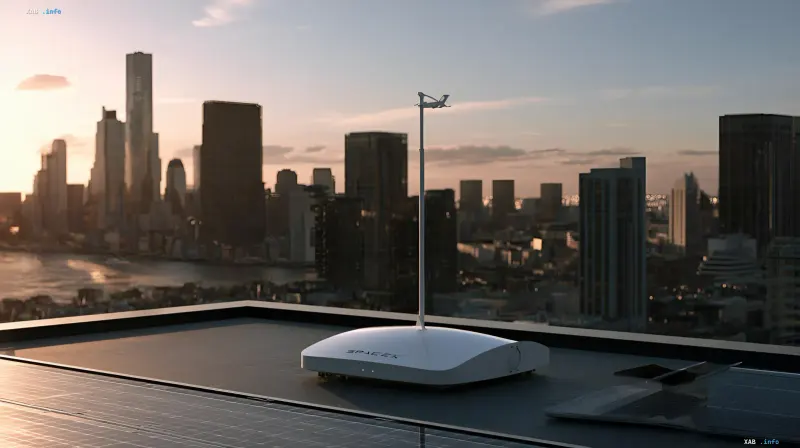
Elon Musk announced that SpaceX is developing a new device for Starlink Mobile subscribers — a compact micro-cellular tower that can be installed directly on a building's roof. According to the company's head, the new product aims to solve one of the key problems of satellite mobile communication: providing a stable signal indoors. In the published images, the device is presented as a flat white casing with the SpaceX logo and a thin vertical antenna, installed on the roof of a multi-story building against an urban skyline backdrop.
The Problem of the 'Last Meters' Indoors
The core idea is to help the signal penetrate thick walls and distribute communication inside buildings. In the current configuration, satellite mobile communication works on the principle of direct reception from a satellite, and in rooms where the direct signal is weakened by building construction, communication quality can be unstable. The rooftop micro-tower, as envisioned by SpaceX, is meant to eliminate this limitation by acting as a local repeater that 'brings' the signal to indoor spaces. Musk has not yet disclosed details about the technical implementation of the device, so specific characteristics — power, coverage radius around the building, compatibility with specific smartphone models — remain unknown.
How Starlink Mobile Works
Starlink Mobile is a direct satellite communication service from SpaceX built on Direct-to-Cell technology. It allows regular 4G/5G smartphones, without bulky external terminals, to exchange SMS, use messengers, and access the internet where there is no terrestrial cellular coverage. The satellites act as 'towers in space'. Previously, a target speed of about 150 Mbps on a standard smartphone was reported, making the service competitive not only as a communication means in 'dead zones', but also as a full-fledged mobile channel.
Context: Frequencies, Spectrum, and Operator Status
The micro-tower announcement fits into SpaceX's broader strategy to turn Starlink into a full-fledged mobile operator. The company previously completed a roughly $17 billion deal to acquire wireless spectrum from EchoStar Corp., and also bought the rights to use radio frequencies in the 800 MHz band from investment firm Grain Management LLC — Musk called this 'the last major puzzle piece'. The Starlink Mobile trademark application filed with the US Patent and Trademark Office mentions personal cellular communication and two-way transmission of text, voice, and audio. Meanwhile, SpaceX is already partnering with T-Mobile US to provide satellite connectivity in areas without traditional coverage, and in September, Musk noted that creating an independent mobile network operator is one of the options under consideration.
Knowns and Unknowns
At present, only SpaceX's intention to develop a rooftop device to improve indoor coverage for Starlink Mobile has been confirmed; launch timelines, pricing, installation requirements, and exact technical parameters have not been disclosed. Thus, the announcement should be viewed as a stage in forming a hybrid Direct-to-Cell ecosystem, in which terrestrial (including rooftop) elements complement low-Earth orbit satellites to ensure a stable signal both in open 'dead zones' and inside buildings.