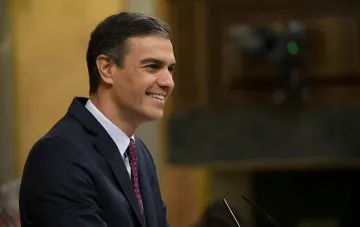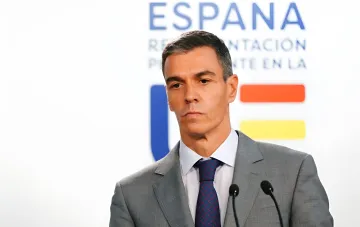
Speaking at a wrestling arena on the island of Tenerife as part of the campaign for Sunday's parliamentary elections, Spanish Prime Minister and Socialist Party leader Pedro Sanchez warned the audience that the number of right-wing governments worldwide is steadily growing. "How did President Trump benefit the United States and, by extension, the whole world—was it a breakthrough or a step backward?" he asked his supporters, before referencing former Brazilian leader Jair Bolsonaro and Argentine President Javier Milei. "If we don't want this for the whole world, why would we want it for our own country?" Sanchez summarized, framing his campaign as a defense of the European left-wing model against a global right-wing trend.
Poll Advantage for the Right and the Shadow of the PP-Vox Coalition
In most polls at the time of the campaign, the opposition conservative People's Party (PP) is in the lead, appearing close to forming a governing coalition with the right-wing party Vox after the elections. The voting is taking place in an atmosphere of deep political polarization: both the left and the right are publicly claiming that their opponents are capable of undermining the democratic foundations of the Spanish state. In Europe, where right-wing governments have dominated in recent years, Sanchez has solidified his reputation as the most outspoken and uncompromising left-wing prime minister on the continent—his sharp rhetoric in defense of feminism, immigration, and green energy, his condemnation of Israel's military actions in Gaza, and his verbal clashes with Trump have only reinforced this image. At the same time, he has secured stable economic growth for Spain and holds significant authority among left-wing figures abroad.
Mutual Accusations: From "Abusive Years" to "Dangerous Psychopath"
Spanish conservatives, conversely, treat Sanchez with open hostility: they view him as an autocrat who neglects the separation of powers, is obsessed with retaining control, and is surrounded, by their account, by a corrupt clique. On the same day Sanchez held his rally in Tenerife, People's Party leader Alberto Nunez Feijoo told supporters at a bullring in Valencia that the last few years of Socialist rule had been "abusive and even humiliating for many people," adding: "We know them; they are capable of anything." A couple of days earlier, Vox party spokesperson Ignacio Garriga went even further, calling Sanchez a "very dangerous psychopath." Both right-wing forces also hint that the government may have manipulated citizens voting by mail, as well as Spaniards living abroad.
An Ideological, Not Programmatic Campaign
According to Complutense University political scientist Cristina Monge, this election campaign is primarily ideological: "it is not so much about voters rewarding or punishing the government for its work or its proposed platform, but about belonging to a particular ideological bloc." To a large extent, the right's hostility toward Sanchez is tied to his reliance on far-left and separatist parties. Ahead of the 2023 general elections, he was harshly criticized for his coalition with EH Bildu, which advocates for Basque independence and has had ties to the disbanded Basque armed group ETA. After those elections, he formed a new government with the support of another separatist party—"Together for Catalonia" (Junts)—in exchange for amnesty for Catalans facing prosecution for their roles in the failed 2017 bid to declare independence. At the time, Nunez Feijoo accused Sanchez of "buying himself a prime ministership in exchange for the impunity of his partners in court." Carlos III University political scientist Guillermo Fernandez Vasquez noted that such parliamentary alliances "fueled the rhetoric of the right and far-right, according to which Pedro Sanchez is an amoral person with no principles who cannot be trusted and who simply wants to stay in power."
A String of Crises and Judicial Investigations
The period between elections has turned into a string of crises for Sanchez: notably, he failed to pass a single budget through parliament, and the prime minister has been overwhelmed by a series of judicial investigations. He admitted he was wrong to trust two close former allies in the Socialist Party—Jose Luis Abalos, sentenced to 24 years in prison for corruption, and Santos Cerdan, who is set to face trial on similar charges. At the same time, Sanchez defended his former Attorney General Alvaro Garcia Ortiz, who was suspended from civil service for disclosing confidential information, and his brother, a conductor named David. An additional indicator of the depth of societal division was a 2025 CIS poll, which showed that approximately one in five young people under the age of 25 in Spain holds a positive view of the Franco dictatorship.