
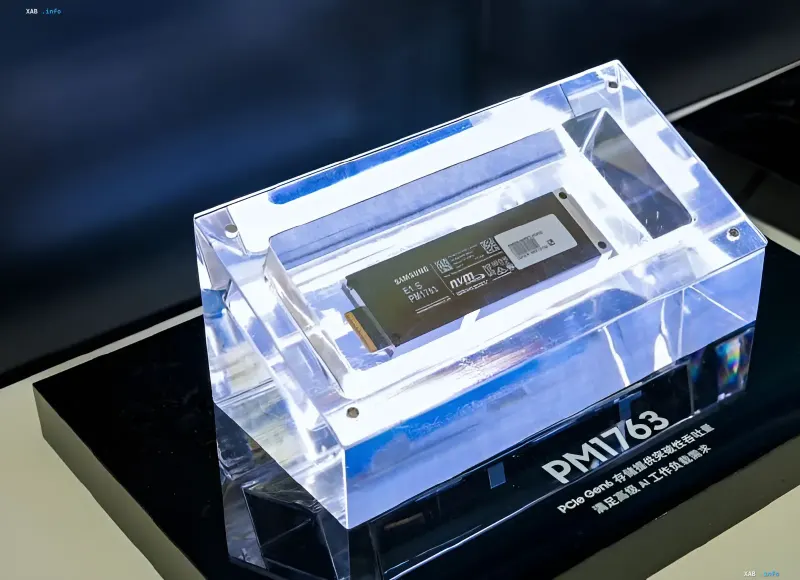
South Korean corporation Samsung Electronics has officially announced the start of mass production of the industry's first enterprise-class solid-state drive (eSSD), the PM1763 model, based on the high-speed PCIe 6.0 interface. According to an official statement from the company's semiconductor division press office dated July 8, 2026, the new storage device is optimized for operation within High-Performance Computing (HPC) server systems and next-generation AI infrastructures, including NVIDIA Vera Rubin hardware platforms.
Technical Specifications and Architectural Innovations of the PM1763
The solid-state drive is designed using Samsung's proprietary 9th-generation V-NAND flash memory and operates under the control of a specialized controller developed using an advanced 4-nanometer (nm) process. The implementation of the PCIe Gen6 data transfer standard enabled the realization of stable PAM4 (Pulse Amplitude Modulation 4-Level) signal modulation, doubling the total bus bandwidth compared to the specifications of the previous generation (PM1753).
Production and Speed Parameters of the Samsung PM1763 eSSD
- Drive capacity (modifications): 4 TB / 8 TB / 16 TB (E1.S, E3.S, U.2 form factors also available up to 64 TB)
- Max sequential read speed: up to 28,400 MB/s (28.4 GB/s)
- Max sequential write speed: up to 21,900 MB/s (21.9 GB/s)
- Energy efficiency (compared to previous generation): 1.8x increase
- Compliance with industry standards: NVMe 2.1 / OCP 2.6
Peak speed indicators were recorded in the flagship 16 TB configuration. Increasing peak performance to 28.4 GB/s reduces latency during data exchange between central processing units (CPU) and graphics accelerators (GPU). In practical terms, this ensures end-to-end transmission of weights for large language models (LLM) up to 40 GB in approximately 1.4 seconds.
Heat Dissipation Systems and Information Security Protocols
The specifics of operating high-density drives in data centers (DC) with high computational loads required the integration of new thermal regulation mechanisms. The PM1763 model is fully adapted for integration into server racks with liquid cooling thanks to support for the Direct-to-Chip (D2C) cooling technology, where contact coolant plates are mounted directly onto the silicon substrates of memory chips and controllers. This prevents thermal throttling during continuous rewrite cycles.
To minimize commercial and regulatory risks in the corporate sector, Samsung has expanded the complex of software and hardware protection for the drive:
- Implementation of Post-Quantum Cryptography (PQC) algorithms, resistant to decryption on prospective quantum computing systems;
- Support for the TDISP (TEE Device Interface Security Protocol) security protocol for trusted execution environments;
- Full compliance with SPDM 1.4 specifications and the US National Security Agency's CNSA 2.0 (Commercial National Security Algorithm Suite) standards.
The start of mass shipments of validated batches of PM1763 eSSDs for the pool of global cloud providers and hyperscalers is scheduled for the third quarter of 2026. Official price lists for retail distributors are currently in the stage of closed commercial negotiation.
According to the regulatory specifications of the PCI-SIG consortium, the integration of the PCIe 6.0 interface imposes strict requirements on PCB topology and signal line quality, meaning that the full deployment of eSSD-class drives requires full compatibility from server chipsets and PCIe switching fabrics.


