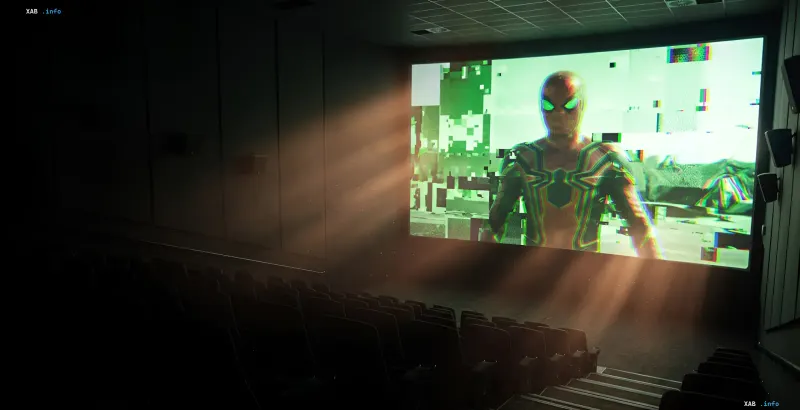
The wide release of the film 'Spider-Man: Brand New Day', which according to Kursiv Media has surpassed the $2 billion mark in global box office receipts, has been accompanied by reports of unstable projection quality in certain cinema halls. Audiences and technical staff of cinema chains have noted image deviations that, according to preliminary assessments, are not related to equipment malfunctions in specific halls but rather indicate peculiarities of the original digital copies distributed in the first wave of the release.
Nature of the Recorded Image Defects
Open discussions and specialized technical forums (including Reddit Cinema Tech) have gathered numerous descriptions of similar deviations. Recurring complaints include: the replacement of deep black in night and interior scenes with greenish-gray noise; loss of sharpness comparable to a compressed video stream, despite the declared 4K format; and uneven manifestation of the color profile — on screens with HDR support, colors are described as oversaturated, while on classic lamp projectors, the image appears dull. Importantly, descriptions of defects vary depending on the projector type, which in itself is a diagnostic sign of a problem at the level of the source package rather than the hall's hardware.
Technical Cause: Error in DCP Master Packages
According to information obtained from cinema chain technical staff, the root cause lies in the DCP (Digital Cinema Package) digital packages delivered by distributors in the first wave of the release. It is indicated that, under tight deadlines before the global premiere, the final stage of grading and tone mapping from HDR to SDR was exported with an incorrect gamma curve. Such an error can simultaneously cause a greenish shift in shadows, loss of contrast, and color rendering discrepancies between HDR and SDR projectors, which aligns with the symptoms described by viewers.
Distributor Response and Copy Replacement Procedure
The Association of Cinema Owners and studio technical services, according to available data, have formed corrected update packages (DCP Patch v1.2). Their delivery is being carried out through secure content distribution channels (Gofilex, Deluxe, CineSend) for re-writing onto cinema servers. The procedure implies a phased replacement of defective copies as patches arrive, which means: the correct version may reach certain halls with a delay relative to other venues.
Contradictory Data
Two interpretations of the origin of the defect coexist in the public sphere. Some viewers and individual hall operators initially linked the problems to the setup or wear of specific cinema projection equipment. Cinema chain technical services, on the contrary, point to a single source — the first batch of DCP master packages — which is confirmed by the identity of symptoms on different types of projectors and across different chains. Until the publication of an independent technical audit of the corrected packages, the final allocation of responsibility between post-production and distribution stages remains open.