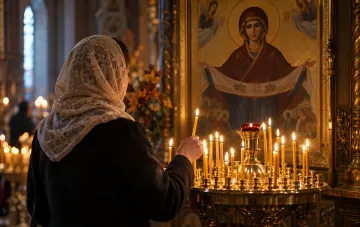

Children look forward to winter holidays with special anticipation, and one of the most awaited is St. Nicholas Day, which in Ukrainian tradition is strongly associated with gifts, sweets, and a family atmosphere. In 2026, according to the new church calendar, this day falls on Sunday, December 6; however, some communities continue to celebrate it on December 19. We explore why two dates of the same holiday actually exist in Ukraine, how the calendar reform was carried out, and where the custom of leaving treats under children's pillows came from.
When St. Nicholas Day is celebrated in 2026
According to the official church calendar, in 2026 St. Nicholas Day according to the new style falls on Sunday, December 6. This date is observed by communities of the Orthodox Church of Ukraine and the Ukrainian Greek Catholic Church, which switched to the Revised Julian calendar for fixed holidays. At the same time, communities that kept the Julian calendar will honor the saint on December 19. That is why both dates can still be found in Ukraine today — and this is not a mistake, but a consequence of the calendar reform carried out by the churches at different times and with varying degrees of obligation.
Why the holiday was moved from December 19
Before the calendar reform, the majority of Ukrainians celebrated St. Nicholas Day on December 19. The turning point was the resolution of the Bishops' Council of May 24, 2023: starting September 1, 2023, the Orthodox Church of Ukraine switched to the Revised Julian calendar for fixed holidays, according to which the remembrance day of St. Nicholas falls on December 6. The Ukrainian Greek Catholic Church also switched to the new calendar. At the same time, the OCU allowed parishes and monasteries that wish to preserve the previous practice to continue living by the Julian calendar. Hence, the double date remains: December 6 for those who switched to the new style, and December 19 for those who remained on the old one.
Where the tradition of giving gifts to children came from
The image of St. Nicholas, known as Nicholas of Myra, dates back to the 4th century: he was a bishop of the city of Myra in Asia Minor, on the territory of modern Turkey, and in the Christian tradition is revered as an example of mercy, generosity, and care for the needy. One of the most famous legends tells how he secretly gave money to three poor girls to save them from poverty — this very story is associated with the tradition of giving gifts secretly, without waiting for gratitude. In Europe, the custom of giving gifts on St. Nicholas Day began to spread back in the Middle Ages: children in monastic schools and orphanages were the first to receive them, and later the tradition entered family celebrations. In Ukraine, it took root in the 19th century, especially in Galicia, along with the development of schooling; Ivan Franko, who wrote the work "The Trial of St. Nicholas," played an important role in popularizing the image. Gradually, the custom of leaving sweets, fruits, or small gifts for children by the bed or under the pillow on the night before the holiday became established.
History of venerating the saint on Ukrainian lands
The veneration of Nicholas came to Ukrainian lands from Byzantium and spread during Kievan Rus. Already in the 11th century, two holidays were celebrated in his honor here: the winter one on December 6 according to the Julian calendar, which corresponds to December 19 according to the modern civil calendar, and the spring one on May 9 according to the old style, associated with the transfer of the saint's relics from Myra to the Italian city of Bari. With the spread of Christianity, Nicholas became one of the most revered saints, and an old Kiev legend about the Tithe Church is also connected with his name: according to legend, Prince Vladimir ordered a separate chapel to be set up in the church in honor of the saint, although the church itself was dedicated to the Mother of God. Over time, Nicholas began to be considered the patron saint of children, travelers, and sailors, and his image turned into a symbol of kindness, protection, and selfless help.
The dual meaning of December 6: Church holiday and Armed Forces Day
In 2026, December 6 unites a church tradition and an important state date. On this day, Ukraine also celebrates the Day of the Armed Forces of Ukraine — the holiday was established by a resolution of the Verkhovna Rada on October 19, 1993, and the date was chosen in honor of the adoption on December 6, 1991, of the Law "On the Armed Forces of Ukraine." Thus, a single date carries both family-church and patriotic symbolism: honoring the patron saint and gratitude to those who defend the independence and territorial integrity of the country. For families planning their celebrations, this is a convenient benchmark: December 6 is Sunday, and on the eve, December 5 in the evening, gifts are traditionally prepared for children to find in the morning under their pillow or by the bed.