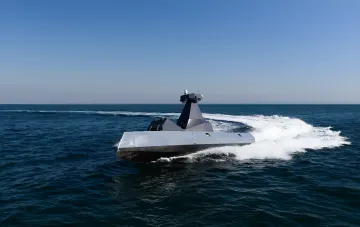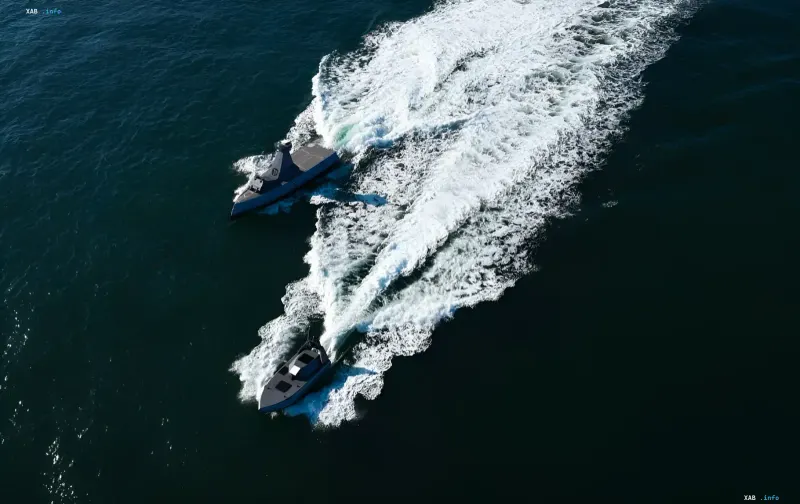
German defense technology company STARK, which operates an R&D center in Ukraine, has announced the development of the 24-meter uncrewed surface vessel (USV) VANTA 24. The machine is designed for operations in European waters and, according to the developers, will be used to track tankers belonging to Russia's 'shadow fleet'. The first maritime demonstration tests are scheduled for 2027, and preparations for serial production are already underway at consortium facilities in Germany and the UK.
Third and largest vessel in the lineup
VANTA 24 will become the third and largest USV in STARK's product line. The vessel will be capable of carrying a payload of up to 50 tons, including anti-ship missiles, and will also be equipped with a 30mm cannon and a 3D radar for detecting air and surface targets. In addition to monitoring the 'shadow fleet', the craft is planned to be used for escorting warships. Its aluminum hull is designed to withstand low temperatures, ice, and heavy seas in the Baltic, while its maximum speed will exceed 35 knots — approximately 65 km/h. The vessel's autonomy will allow it to remain on mission for several weeks without returning to base.
The Baltic and North Sea as a 'new battlefield'
According to STARK CEO Uwe Horstmann, the Baltic and North seas are turning into a 'potential new battlefield', and the company is purposefully developing defense systems specifically for this region. He emphasized the economic and operational advantages of autonomous maritime platforms: 'These are systems that cost a fraction of the price of a crewed frigate, which takes years to build.' According to his assessment, STARK's marine platform can be deployed in a matter of months, making response speed a key factor. In addition to the Baltic, VANTA 24 will be able to operate in the North Sea, the North Atlantic, and Arctic waters.
Minerva artificial intelligence and modular architecture
Control of VANTA 24 will be provided by STARK's proprietary artificial intelligence system, Minerva. It is responsible for autonomous navigation and mission execution, and also integrates into existing Allied naval combat management systems. The vessel's modular design, the company states, will enable serial production. Previously, STARK introduced two smaller platforms: the 6-meter VANTA 6 USV with a payload capacity of up to 750 kg, capable of carrying the Cascade loitering munition, and the 12-meter VANTA 12 USV with a payload capacity of up to 2 tons, which can be armed with the Sea Venom anti-ship missile.
Context: 'shadow fleet' and Ukrainian-German cooperation
The 'shadow fleet', as defined by the developers, helps Russia bypass international sanctions and continue exporting oil: such tankers often have opaque ownership structures, sail under third-party flags, and conceal location data, complicating shipping monitoring and increasing risks for maritime security and underwater infrastructure. Germany remains one of Ukraine's key military partners: in September, Defense Minister Yevhen Khmara and his German counterpart Boris Pistorius agreed to continue support, calling the development of a joint defense industry a priority. Uncrewed maritime platforms are also actively used in Ukraine — on September 12, the Navy together with the HUR reported that a Ukrainian Sargan 3000 drone destroyed a Russian uncrewed surface vessel in the Black Sea, which was called the first-ever naval battle between USVs.