
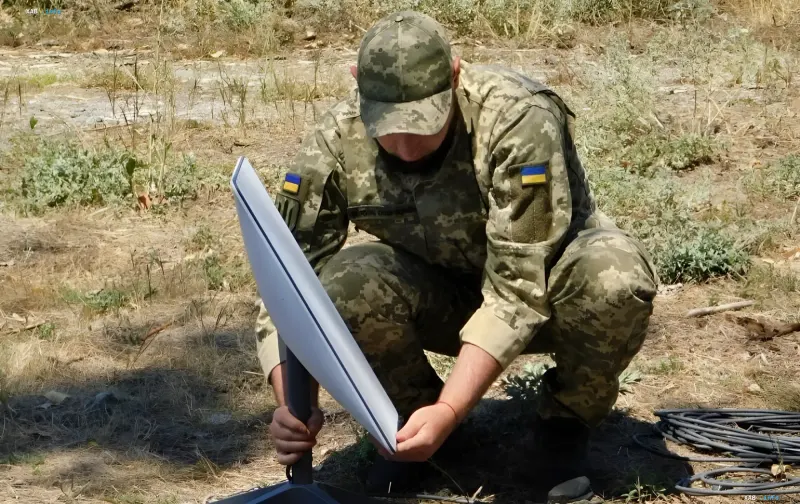
The Russian Federation and the People's Republic of China have developed a large-scale strategy aimed at the physical destruction of the Starlink satellite network. Beijing and Moscow are coordinating joint measures against Elon Musk's company, seeking to neutralize the technological advantage that this system provides on the battlefield.
This information became available thanks to an investigation by The Insider, the materials of which were published by RBC-Ukraine. Journalists gained access to confidential documents from the Third China-Russia Forum, held in Guangzhou in November 2023. The authorities of both countries have not officially publicized the existence of this platform, however, investigators studied four presentations and a working protocol of the negotiations.
From Diplomacy to Military Countermeasures
The documents reveal detailed coordination of efforts in critical areas of defense. The Chinese side proposed a phased strategy to Russian partners to combat SpaceX satellites. The initial stage of the plan involves the formation of an international coalition. The goal is to achieve regulatory restrictions for the American company by appealing to the risk of collisions of spacecraft in low Earth orbit.
The next step involves a fight for the frequency spectrum. The countries plan to submit joint applications for orbital positions earlier than the Americans, which will allow them to block the development of the system through international regulatory bodies. The authors of the document directly call this approach a military countermeasure.
At the same time, the allies are developing electronic warfare systems. New technologies will allow selectively disabling Starlink communication in specific areas using power suppression and adaptive interference.
Physical Elimination of the Threat
The most aggressive part of the plan concerns the physical destruction of satellites. The presentation on this issue was prepared by researchers from the China Aerospace Science and Technology Corporation (CASC) — the main space contractor of the PRC.
Engineers propose creating inexpensive weapons for attacks in space based on the "one against many" principle. The key idea is that the cost of the strike should be minimal. Russia and China intend to destroy satellites faster than SpaceX can launch new ones, creating a constant communication deficit for the enemy.
Exchange of Technologies and Combat Experience
According to the report, it is proposed to establish a regular transfer to China of data on the combat operations of Russian drones in Ukraine. China has a huge arsenal — 160 types of loitering munitions from more than 50 manufacturers, but it practically lacks real combat experience in their use.
Russia, on the other hand, possesses data on the combat use of drones. The plan provides for the formalization of the exchange: Russia shares knowledge from the battlefield, while China provides artificial intelligence technologies and mass production resources for the joint development of the next generation of autonomous "swarm" munitions.
The publication notes that this exchange mechanism is already functioning. The autonomous V2U drone used by Russian troops operates on Chinese artificial intelligence modules, lidar sensors, batteries, and solid-state drives. Participants of the forum in Guangzhou discussed how Chinese engineering solutions would be tested on the battlefield in Ukraine.
Reaction and Context
China has not demonstrated a noticeable reaction over the past six months to the materials transferred by Ukraine, proving the use of Chinese components in Russian weaponry. At the same time, the share of Chinese components in Russian military equipment continues to grow. President Volodymyr Zelenskyy previously stated that Ukraine possesses evidence of China supplying weapons to the Russian Federation, although Beijing officially denies this.
Nevertheless, there are nuances in the relations between Beijing and Moscow. President Zelenskyy reported that China has warned Russia in a harsh and ultimatum form against any statements about the use of nuclear weapons for the first time, demonstrating that the strategic interests of the countries do not always fully coincide.


