
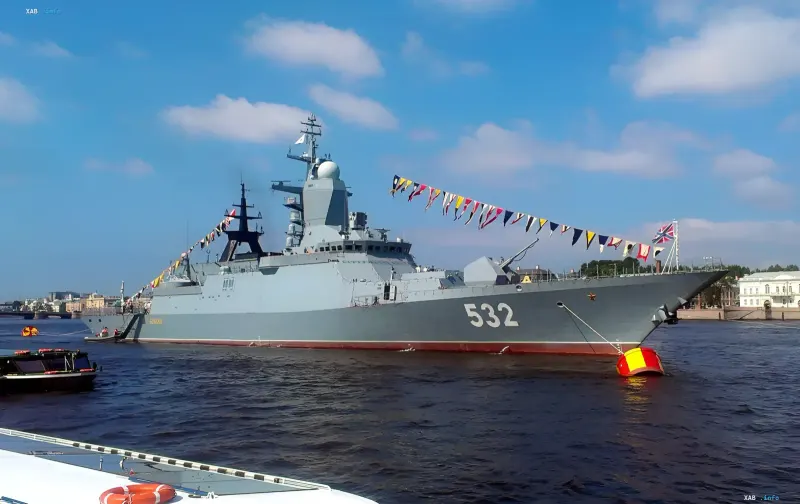
The events in Kronstadt on June 3, 2026, marked a pivotal moment for naval strategy in the region. In the Velechinsky dry dock, located in St. Petersburg, the corvette 'Boykiy' — one of the key warships of the Russian Baltic Fleet — was struck. The attack was carried out by operators of the 1st Separate Center of the Unmanned Systems Forces of Ukraine.
Corvette 'Boykiy': specifications and role in the fleet
'Boykiy' is a Project 20380 corvette, built in 2011 and commissioned into the Russian Navy in 2013. The ship is equipped with guided missile armament and is designed for operations in coastal zones, as well as for escorting merchant vessels and tankers. In recent years, it has been actively used for patrolling near NATO borders and ensuring logistics for Russia's shadow oil fleet.
Since February 2026, the corvette has been undergoing scheduled repairs in Kronstadt. It was at this moment, when the vessel was most vulnerable, that the strike was delivered. The destruction of 'Boykiy' not only deprived the Russian fleet of an active combat unit but also demonstrated Ukraine's ability to deliver precision strikes on enemy military objects even at a significant distance from the front line.
Operation in Kronstadt: scale and consequences
The strike on 'Boykiy' was not an isolated incident. On the same day, Ukrainian drones attacked other ships and port infrastructure objects in Kronstadt. The General Staff of the Armed Forces of Ukraine confirmed the operation, and Ukrainian President Volodymyr Zelenskyy personally announced night strikes on St. Petersburg, Kronstadt, and Tambov.
Units of the SBU, Special Operations Forces (SSO), the Main Directorate of Intelligence (HUR), and the State Border Guard Service were involved in the operation. This indicates a high level of coordination between various security structures and suggests that such actions are becoming part of a systemic strategy.
Impact on the combat capabilities of the Russian fleet
The loss of 'Boykiy' weakens Russia's naval potential in the Baltic. The ship was not just a fleet unit — it performed critical tasks, including escorting tankers and patrolling near NATO borders. Its destruction creates a gap in the Russian fleet's defensive and offensive capabilities in the region.
Furthermore, the success of the operation demonstrates that Ukraine is capable of effectively using unmanned systems to achieve strategic goals. This could set a precedent for future operations and change the approach to planning military actions in the context of asymmetric warfare.
Conclusion
The destruction of the corvette 'Boykiy' is not just a tactical success. It is a signal that Ukraine is capable of striking Russian military objects even deep within its territory. Such actions undermine confidence in the security of Russian military bases and could influence the future strategy of the Russian Navy. In the context of the ongoing conflict, such operations are becoming increasingly significant and may alter the balance of power in the Baltic.


