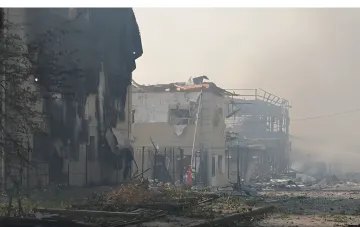
On the evening of August 28, Russian attack drones struck warehouses in the village of Mila in Bucha District of Kyiv Oblast. The fire that broke out after the impact was accompanied by a series of explosions and the subsequent detonation of stored munitions. By the morning of August 30, according to data published by Volodymyr Zelensky in his Telegram channel and reported by RBC-Ukraine, the number of people killed as a result of the strike and detonation had risen to 38. A further four people are missing, and searches for them are ongoing.
Victims and impact on the population
According to the President of Ukraine, 20 people were injured in the incident, including two children. Among the dead is Taras Didych, head of the Dmytrivka community. Residential houses and a sanatorium were damaged in the affected area, and a mass evacuation of the population is underway in the vicinity of the village. Due to the large-scale fire, traffic of all types of vehicles was temporarily closed on the M-06 "Kyiv — Chop" highway between the 15th and 32nd kilometers.
Work of rescuers and pyrotechnicians
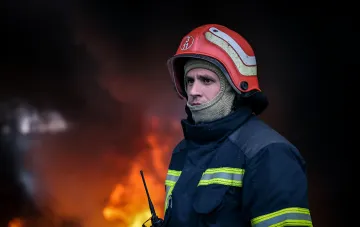
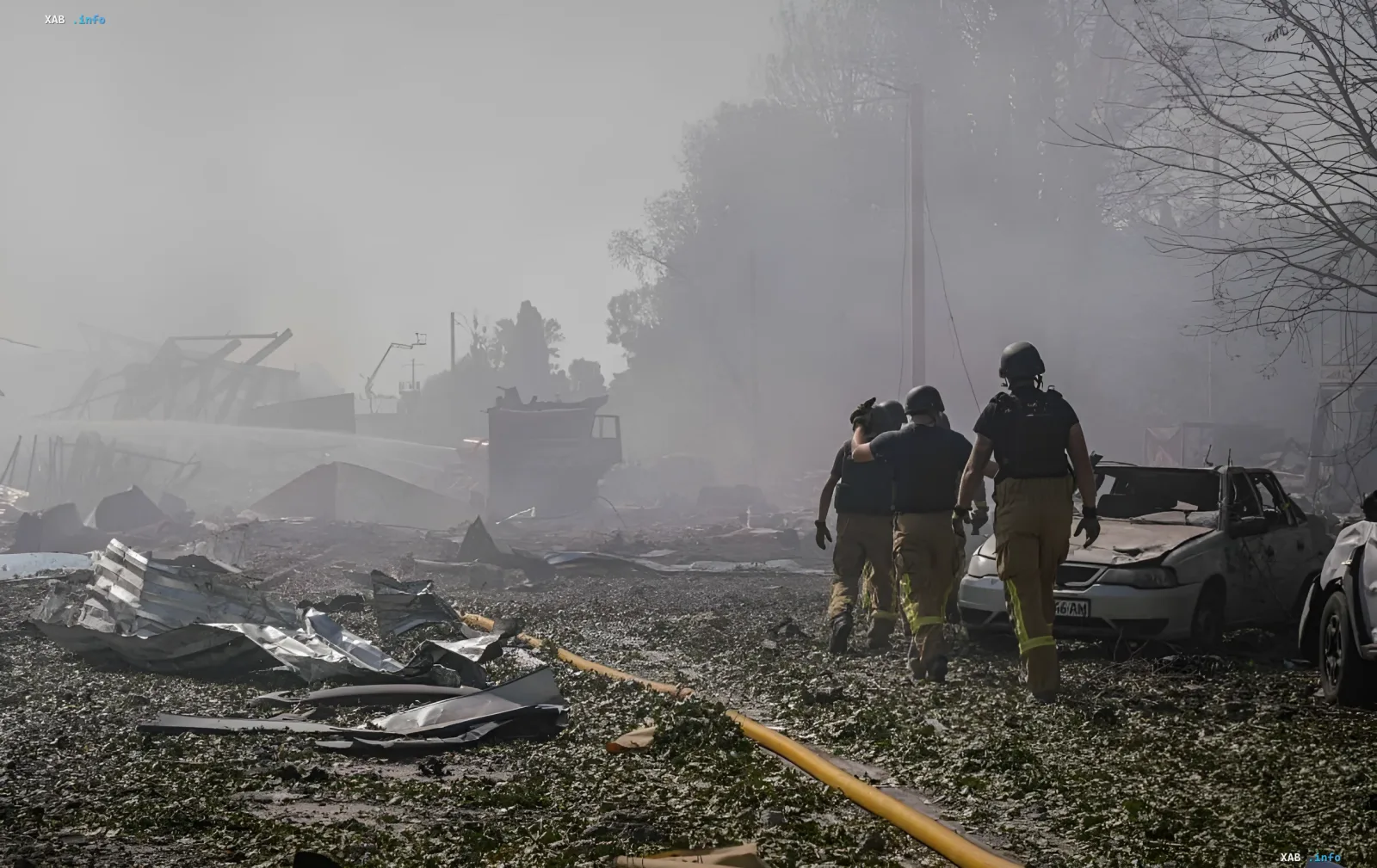
Zelensky reported that rescuers had managed to extinguish most of the fires in the village of Mila, however, work to eliminate the aftermath is continuing around the clock. Pyrotechnic units of the State Emergency Service (SES) are on duty at the site on a 24-hour basis, detecting and defusing explosive items. The head of state emphasized that "the scale of contamination of the territory is significant" and that this work will continue "for as long as necessary." According to available data, forces from four regions were involved in eliminating the aftermath.
SBS investigation and legal context
The Security Service of Ukraine (SBU) opened a criminal case on two grounds: on the fact of the Russian strike on facilities in the village of Mila, and on the fact of a repeat (secondary) detonation. The investigation, as noted, is being conducted under the article on negligence of duty. Physical evidence has already been sent for the corresponding expert examinations. Thus, the official legal qualification of the event combines both an external military context and an internal one — the question of responsibility for storage conditions and the circumstances of the secondary explosion.
Contradictory data
There are several points in the available sources where versions and formulations diverge. First, the nature of the detonation is described differently: one set of reports speaks of a single "subsequent detonation" after the strike, whereas the SBU and some media outlets (including Gazeta.ua) speak of a "repeat" or "second instance" of munitions detonation — that is, an additional explosion distinct from the initial one. Second, the event is simultaneously presented in two legal dimensions: as a "Russian crime" and a military strike (Zelensky's position) and as a case of "negligence of duty" (the SBU's position), which in fact shifts part of the emphasis to internal responsibility for storage. Third, the weekly weapons statistics cited by the president are based on official statements and have not been confirmed by independent fact-checking. These discrepancies do not change the basic fact of 38 dead, but they require careful interpretation of the details.
Broader context: weekly strike statistics
Commenting on the incident in Mila, Zelensky cited weekly data: over this week, according to him, Russia launched almost 2,000 attack drones, more than 1,600 aerial bombs, and 31 missiles of various types, including a North Korean ballistic missile, at Ukraine. He noted that strikes on front-line and border communities — Nikopol, Kramatorsk, Kherson, the communities of Kharkiv, Zaporizhzhia, Dnipro, Donbas, and Sumy regions — are effectively being carried out around the clock. "For every Russian strike and crime, we seek just responses. They will definitely come," the president stated.