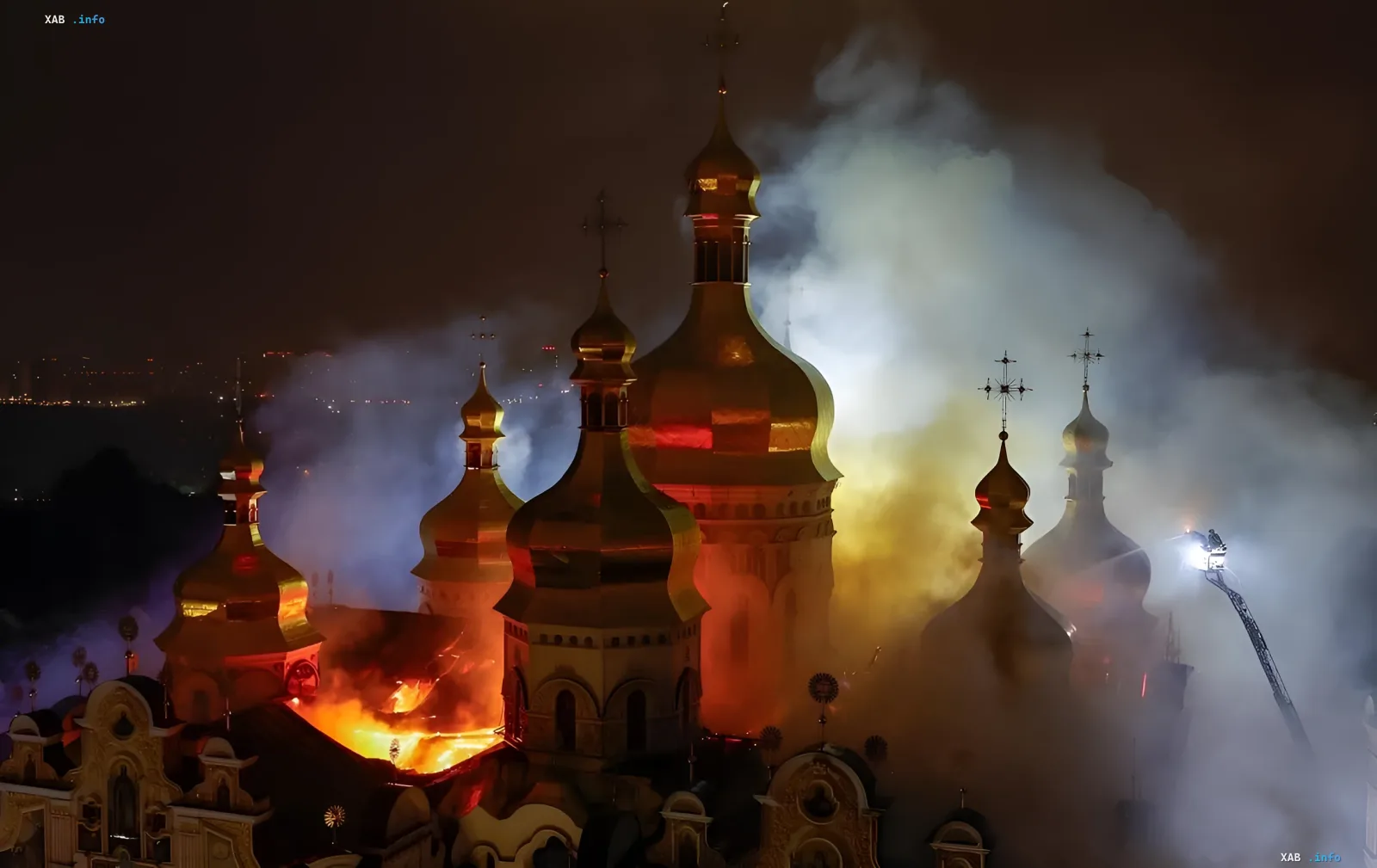
On the night of June 15, a powerful explosion rocked Kyiv, becoming one of the most resonant events of the entire conflict. The target of the massive attack was the Kyiv Pechersk Lavra — the oldest Orthodox monastery, a UNESCO World Heritage site, and a symbol of Ukrainian statehood. Fire engulfed the roofs of the Dormition Cathedral, while thick smoke enveloped the golden domes, creating a spectacle that shocked the entire world.
Massive Attack and Scale of Destruction
On the night of June 15, Russia used an unprecedented amount of weaponry against the Ukrainian capital. According to Ukrainian authorities, more than 680 munitions were launched: Iskander ballistic missiles, Zircon hypersonic missiles, cruise missiles, and hundreds of drones. The air defense system operated at the limit of its capabilities, destroying or suppressing 632 aerial targets. President Volodymyr Zelenskyy later confirmed that the interception of ballistic missiles was made possible thanks to a new package of Patriot systems.
The consequences of the strike were catastrophic. A fire engulfed the territory of the Lavra, causing serious damage to the Dormition Cathedral. Both the interiors and the exterior appearance of the main temple were damaged. The fire spread to neighboring structures, including elements of the fortification complex and the tower of Ivan Kushnyk. As a result of the attack, five people were killed and more than 30 were injured in 10 districts of Kyiv.
Reaction of International Organizations
The events surrounding the Lavra provoked an immediate and harsh reaction at the level of world institutions. Council of Europe Secretary General Alen Berse called the incident "another escalation of destruction." In his statement, he emphasized that the site is part of the common cultural heritage of Europe and highlighted the organization's intention to continue working on holding Russia accountable.
UNESCO also condemned the attack. The organization clarified the details of the destruction and noted that attacks on cultural values and educational institutions are a violation of international law. UNESCO stated its readiness to assist Ukrainian authorities in assessing the damage and determining priority restoration measures.
Position of G7 and EU Leaders
Leaders of the "G7" countries and the European Union used this incident as an occasion to tighten rhetoric and take concrete actions. French President Emmanuel Macron called the Lavra one of the highest places of Ukrainian Orthodoxy. He stated that, just as in the case of war, nothing justifies an attack on "universal heritage." Macron promised to raise the issue of restoring the site at the G7 summit in Evian and confirmed France's readiness to cooperate with Ukraine.
EU Foreign Policy Chief Kaja Kallas linked the attack to immediate sanctions. On the same day, the European Union introduced additional restrictions against the Russian military-industrial complex and the shadow fleet. "These are war crimes, and Russia will have to answer for them," Kallas wrote, noting that each new package of sanctions narrows the Kremlin's room for maneuver.
European Commission President Ursula von der Leyen reminded that increasing pressure on Russia would be one of the central themes of the meeting in Evian. She emphasized that Europe wants peace, but Russia is demonstrating an exceptional interest in violence.
Condemnation from Italy and Moldova
The reaction received a particular emotional coloring in the statements of Italian politicians. Foreign Minister Antonio Tajani stated that Moscow does not want peace and called on the Kremlin to be careful not to offend the feelings of all Christians. Culture Minister Alessandro Giuliano called the destruction of a heritage site a "crime against the memory and identity of peoples." Prime Minister Giorgia Meloni stated that Russia's aggression is unacceptable and called for firm support for Kyiv, as attacks do not stop even before the millennial symbols of Christianity.
In Moldova, the incident also caused a resonance. President Maia Sandu stated that "the Kremlin regime has once again shown that nothing is sacred to it." Parliament Speaker Igor Grosu called the strike "inhumane," and the country's leadership confirmed its solidarity with Ukraine.
Outcomes and Consequences
The strike on the Kyiv Pechersk Lavra became a turning point in the information space. It united the international community in condemning Russia's actions and led to the immediate introduction of new sanctions. For Ukraine, this event became a symbol of resilience, and for the international community — proof that the war has crossed the line, affecting not only military infrastructure but also cultural values belonging to all humanity.


