
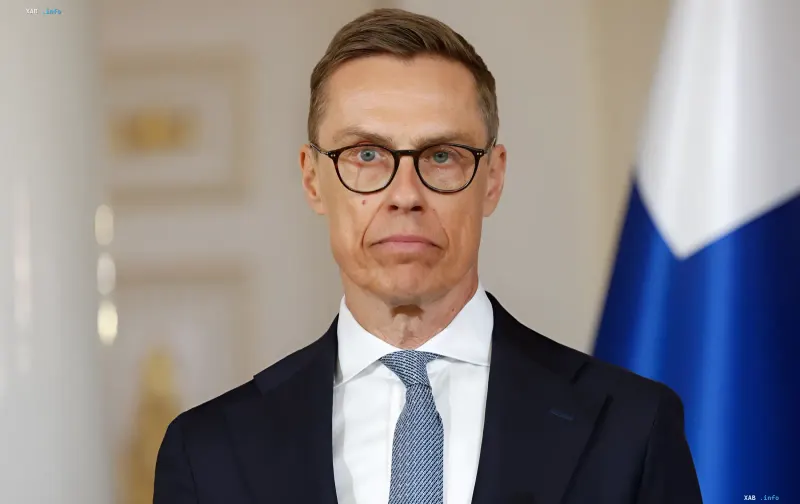
Finnish President Alexander Stubb has made a bold statement regarding the current situation on the front lines. In his view, Ukraine is currently in its best military position since the beginning of the full-scale invasion. In an interview with the Swiss newspaper NZZ, published by RBC-Ukraine, the Finnish leader revealed details that, in his opinion, indicate a shift in the balance of power.
The Mathematics on the Battlefield
Stubb divided the course of the war into three key stages. He characterized the first year as a time of struggle for survival. The following three years passed under the sign of a test of resilience. However, according to the President, the situation has now moved into the phase of "mathematics on the battlefield".
This conclusion is based on specific figures regarding losses and recruitment. Stubb claims that the Russian army's monthly losses amount to approximately 35,000 people, while Moscow is only capable of recruiting 27,000 new fighters. This imbalance, according to the Finnish leader, is a fundamental factor giving Kyiv an advantage.
Historical Perspective and Speed of Advance
To illustrate the inefficiency of Russian military efforts, Stubb drew a historical analogy with World War II. He reminded that it took the Soviet army four years to travel the path from Moscow to Berlin — a distance of about 1,600 kilometers. In comparison, over a similar period in the current conflict, Russian troops have advanced approximately 60 kilometers.
According to the President of Finland, this contrast proves Ukraine's superiority and the Russian army's inability to achieve its strategic goals in the short term.
Threat to Article 5 and the Internal Situation in the RF
Responding to Western partners' concerns about a possible Russian test of NATO Article 5 (collective defense) after the end of the war in Ukraine, Stubb expressed skepticism. He posed a rhetorical question: why would Russia test alliance obligations if it failed to conquer Ukraine in four years?
The President of Finland admitted the possibility of hybrid tests from Moscow — cyberattacks or sabotage — but ruled out the likelihood of kinetic military provocations. "People just need to calm down. I understand public debate, but I see all the intelligence reports — I read them very carefully," he emphasized.
Regarding the internal situation in Russia, Stubb stated that the majority of the population is currently against the war. This, according to him, is facilitated by Ukrainian drone and missile strikes deep into Russian territory, including the direction of Moscow and St. Petersburg, as well as internet restrictions. The President noted that Vladimir Putin's blocking of Telegram and WhatsApp messengers has begun to negatively affect the real lives of Russians.
Negotiation Strategy
Alexander Stubb spoke in favor of dialogue with the Russian leadership but set a strict condition: negotiations are possible only when Russia does not have a strong position. He also urged Europe to consider whether current US foreign policy corresponds to the continent's interests and, if necessary — to act independently.
According to the Finnish leader, the first step should be a dialogue on behalf of the European Union. If this format does not work, one can move to the E3 format (France, Germany, UK) or other diplomatic initiatives. Earlier, Stubb had already stated that he was ready to personally lead EU negotiations with Russia if necessary.


