Skinny trousers still hold a firm place in a trendy wardrobe, yet they are often the reason for disproportionate and visually "compressed" outfits. In a post on her Instagram page, stylist Olena Shevchenko analyzed the three most popular styles—skinny jeans, straight-leg trousers, and leggings—and offered specific formulas for pairing tops and footwear for each. The key principle she emphasizes: a narrow bottom requires compensation with volume, length, or texture in the top part, otherwise, the silhouette loses balance and looks outdated.
Skinny jeans: Balancing narrow legs with volume and chunky footwear
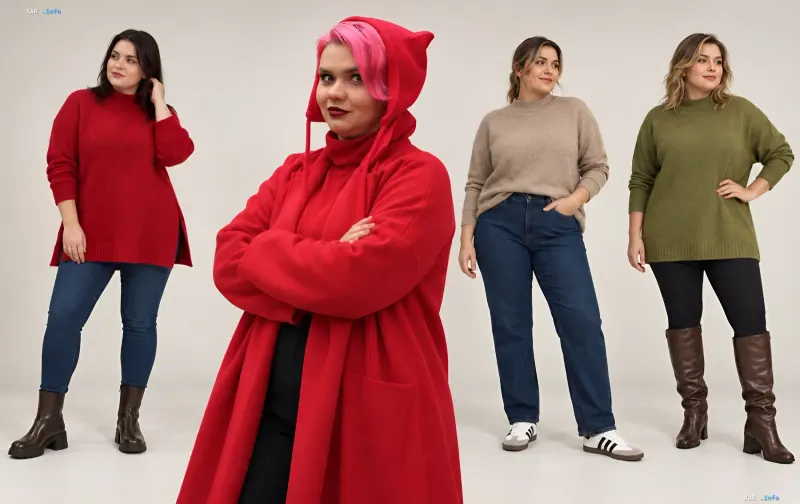
For skinny jeans, Shevchenko recommends choosing a top that adds volume and balances the silhouette. As basic options, she suggests a spacious sweater, a loose shirt, or an elongated blazer. An alternative technique is an oversized long top, which creates a play of proportions and prevents the outfit from looking too skin-tight. The tucking technique deserves special attention: voluminous items can be tucked into the pants to clearly define the waistline while maintaining a sense of ease. Regarding footwear, the stylist suggests chunky boots with a massive sole and a bold silhouette—such a contrast with narrow pant legs gives the look character and completeness.
Straight-leg trousers: Three scenarios for maximum freedom
Straight-leg cuts, according to Shevchenko, offer significantly more room for experiments. The first scenario is a voluminous top tucked into the trousers: a sweater or shirt that highlights the waist and makes the silhouette more expressive. The second is a loose top reaching the hip bones, which does not overwhelm the outfit and organically matches the straight line of the trousers. The third is a voluminous but form-fitting top, allowing one to combine the comfort of a loose cut with a more defined silhouette. Furthermore, the stylist permits wearing straight trousers with a loose top untucked—this is a relaxed option for casual looks.
Leggings: The tight fit dictates the choice of the upper part
Leggings differ from other models in that they fit the legs snugly, so the upper part of the outfit requires careful consideration. Shevchenko suggests three directions. First, an elongated fitted top: a tunic, a long knit sweater, or another item that gently follows the body's lines but covers the hips. Second, a loose elongated top: an oversized sweater, a spacious shirt, or a long sweatshirt that creates a relaxed silhouette. Third, a short fitted or voluminous top, exposing the waistline or ending above the hips, allowing for playing with proportions. For footwear, the stylist highlights two options: low-cut loose footwear that does not grip the ankle, or high boots that form a complete ensemble with the leggings.
General principle: A balance of volume, length, and texture
To conclude, Shevchenko emphasizes that the successful combination of narrow trousers with other elements of an outfit depends not only on the cut of the trousers themselves but also on how the volume of the pieces, the length of the top, and the shape of the footwear relate to each other. Adhering to these three parameters allows even visually similar models—skinny jeans, straight trousers, and leggings—to be worn in fundamentally different stylistic contexts, avoiding monotony and visual overload.