
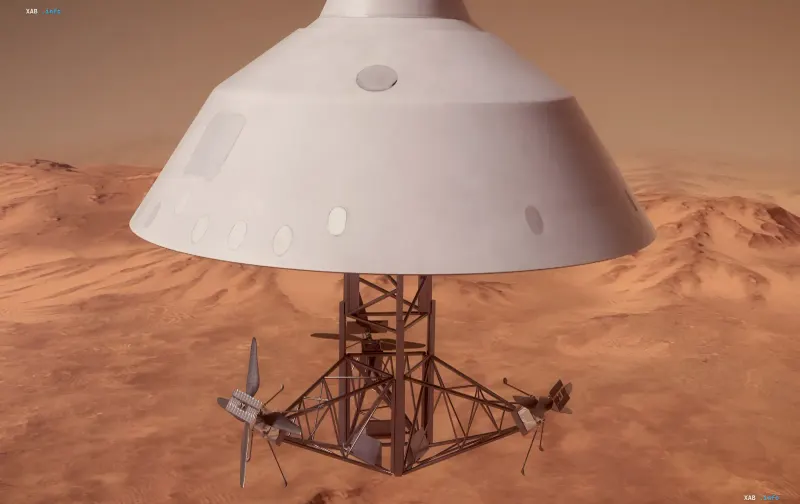
The era of robotic scouts on Mars is reaching a new level. If the Ingenuity mission proved the very possibility of flight in the thin atmosphere of the Red Planet, then the next Skyfall expedition, scheduled for the end of 2028, intends to turn these flights into full-fledged heavy work. NASA engineers have developed a fundamentally new design capable of not just hovering in the air, but transporting serious scientific equipment.
Breaking the sound barrier in a vacuum
The main difficulty of Martian flights lies in physics: the planet's atmosphere is so thin that its density is only 1% of Earth's. Due to the lack of air molecules, it is difficult for rotors to generate lift. The previous Ingenuity helicopter was forced to limit its rotation speed to avoid turbulence and unpredictable flow behavior, operating within 0.7 Mach.
For the new vehicle, NASA decided to go all in. During laboratory tests at JPL (Jet Propulsion Laboratory), engineers accelerated the prototype's rotors to 870 km/h. This allowed them to break the sound barrier in Martian conditions. Successful tests confirmed: the design withstands supersonic loads. This is critically important, as it is this speed that will allow helicopters to lift heavy scanners and cameras for detailed mapping of the terrain for future manned missions.
A deadly dance during landing
The Skyfall mission moves away from proven but bulky landing schemes, such as the "sky crane" (used for Curiosity and Perseverance) or inflatable airbags. Instead, NASA is implementing a bold strategy of autonomous descent:
- Three Ingenuity-class helicopters will descend into the atmosphere inside the mother ship.
- Directly during the descent of the landing platform, the drones will start their engines, detach from it in the air, and fly to the surface on their own.
- Landing safety will be fully controlled by the intelligent onboard Autonomy system.
In the event of malfunctions or encountering a sandstorm, the artificial intelligence will independently stabilize the vehicle and find a safe landing site, eliminating the human factor.
Nuclear revolution in space
The Skyfall mission will be the first interplanetary flight where a nuclear electric power system is used instead of traditional solar panels. Researchers explain this step as necessary: ordinary photovoltaic cells are inefficient at great distances from the Sun, and fuel tanks severely limit the weight of the ship.
Using nuclear energy will remove restrictions on the range of robot flights — the duration of the mission will now depend solely on the durability of the mechanics. This technology will become the foundation not only for Martian expeditions but also for NASA's future permanent base on the Moon. The developed Lunar Reactor-1 (LR-1) nuclear reactor will provide the colony with uninterrupted energy during extreme lunar nights lasting 14 Earth days in a row.


