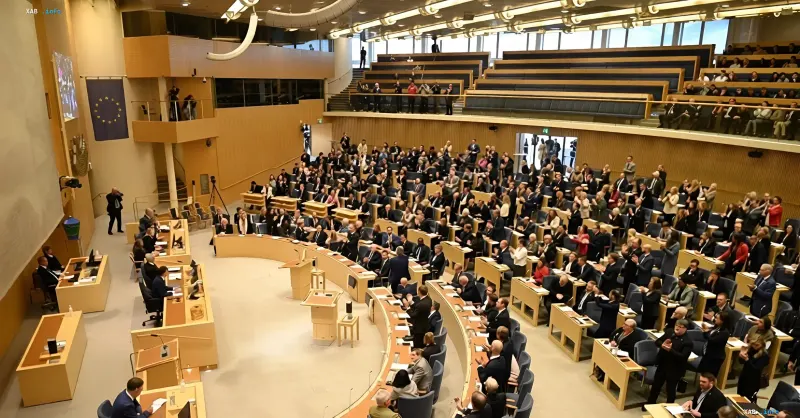
On November 3, the Swedish parliament (Riksdag) rejected the proposal to appoint Elisabeth Tand Ringqvist, leader of the Centre Party, as prime minister. Following the vote, 324 deputies voted against and 25 in favor, with all "yes" votes cast by members of Tand Ringqvist’s own party. This is the second time since the September 2026 general election that parliament has failed to approve a candidate for head of government, cementing the impression of a deep political stalemate in the country.
Voting Figures and Their Significance
The November 3 result—324 against to 25 in favor—shows that Tand Ringqvist’s candidacy lacked a single vote of support outside her own faction. Approving a prime minister in Sweden requires the support of a majority in the Riksdag, and such a crushing defeat makes it obvious that a centrist figure cannot form the basis for a new cabinet. All 25 "yes" votes belonged to the Centre Party, highlighting the candidate's isolation in the inter-party landscape.
Preceding Rejection of Andersson's Candidacy
Earlier, on October 15, parliament also rejected the candidacy of Magdalena Andersson, leader of the Social Democratic Party: 248 deputies voted against, and 99 voted in favor. Thus, both key figures of the center-left bloc claiming to form a government failed to receive the necessary support. Although all four center-left parties—Social Democrats, Left, Greens, and Centrists—supported Andersson for prime minister, they never agreed on which specific parties would enter the new government.
Balance of Power After the September 13 Elections
In the September 13 general election, center-left parties collectively won 176 of the 349 seats in parliament, slightly ahead of the center-right bloc led by incumbent Prime Minister Ulf Kristersson, which secured 173 seats. The three-seat margin makes it impossible for either block to form a stable majority alone and turns the question of coalition partners into the central knot of the crisis. This narrow margin explains why neither side can quickly muster the necessary support.
Tand Ringqvist's Withdrawal and Attempt to Break the Deadlock
Last week, Tand Ringqvist abandoned attempts to form a centrist coalition and stated she did not intend to serve as prime minister in the next government. Putting her candidacy to a vote on November 3 was seen as a tactical step aimed at unblocking the situation, but the parliamentary result confirmed that this path is a dead end. The centrist leader’s refusal to participate further in cabinet formation additionally narrows the room for compromise.
What's Next: Kristersson and the Risk of Early Elections
Immediately after the November 3 vote, Parliament Speaker Andreas Norlén announced that the leader of the Moderates, Ulf Kristersson, would be tasked with forming a government. However, there are currently no signs that Kristersson will secure the necessary support in the Riksdag. If this attempt fails, the task of forming a government may return to Andersson. According to Swedish rules, the speaker of parliament is entitled to put a maximum of four candidates for prime minister to a vote; if all four are rejected, the country will be forced to hold early elections within three months.