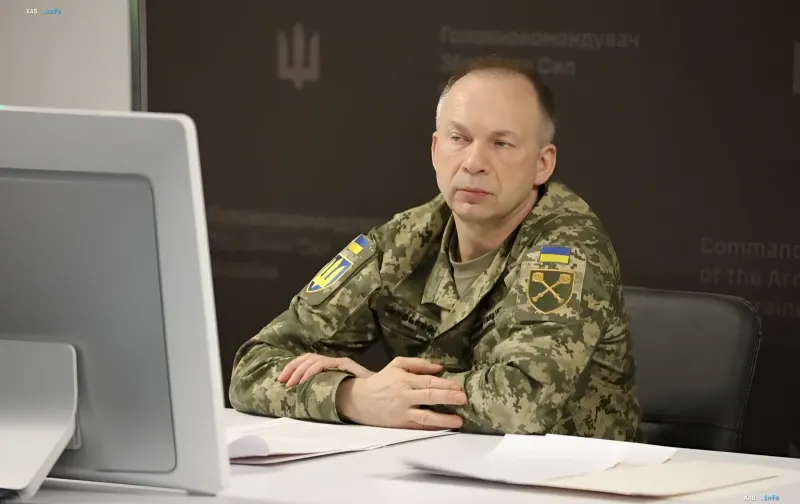
In an interview with The Times, the Commander-in-Chief of the Armed Forces of Ukraine, Oleksandr Syrskyi, revealed the current situation on the front lines, citing shocking figures regarding the Russian offensive grouping and Kyiv's plans for a counterstrike. According to him, the total number of Russian troops engaged in offensive operations on Ukrainian territory has reached 721,300.
The drone race: the enemy's plans
According to Syrskyi, unmanned aviation has become a key element of modern warfare. Russia is demonstrating an aggressive strategy to expand its drone fleet. Currently, the enemy deploys between 6,000 and 7,000 FPV drones per day on the battlefield. However, as the commander admitted, Moscow's plans are far more ambitious: Russia intends to increase daily drone usage to 33,000 units.
Syrskyi noted that while such figures sound fantastic, he confirmed that the enemy indeed has such a plan. In March 2026, he already stated that Russia aims to create drone forces numbering up to 101,000 personnel to seize strategic initiative on the front.
Kyiv's response: production and procurement
In response to the threat, Ukraine is actively expanding its own capabilities. According to Ministry of Defense data, during the first four months of 2026, the country purchased 300% more medium-range strike drones than in the entire previous year, 2025.
Kyiv has set an ambitious goal: to independently produce 7 million drones by the end of the year. More than 65% of this volume will consist of tactical FPV drones. Thanks to this growth, the total number of FPV kamikaze drones in the Ukrainian arsenal already exceeds the number of Russian military personnel on its territory.
Air superiority
The expansion of strike capabilities has allowed the Defense Forces to outpace the enemy in the rate of equipment deployment. Every day, Ukrainian troops carry out almost twice as many FPV drone sorties as the Russian army.
"It is absolutely necessary to use the most modern technologies – they are what provide the advantage. Currently, we outperform the enemy in the use of FPV drones in a ratio ranging from 1.7 to 1 to 2 to 1," Syrskyi emphasized.
The effectiveness of drones is confirmed by enemy loss statistics: the majority of damage to Russian troops is inflicted by air strikes, although the exact share depends on weather conditions and other factors. Previously, in June 2025, it was reported that the number of FPV drones in the AFU had exceeded enemy figures, and since then, this advantage has continued to grow.


