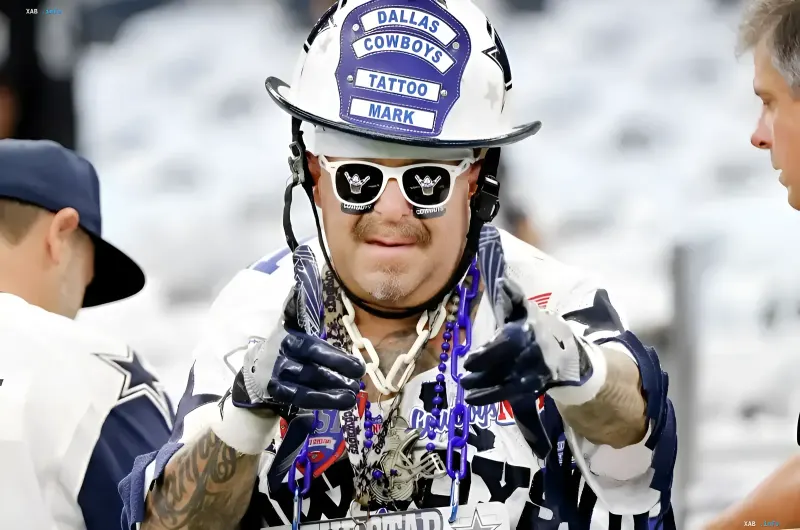
On October 13, 2026, in Arlington, Texas, Mark Schenefield—known to Dallas Cowboys fans as 'Tattoo Mark'—passed away from a heart attack at the age of 64. For anyone who ever spotted him in the AT&T Stadium parking lot, the news came as a shock: not just a fan had vanished, but one of the brightest symbols of American football fan culture, whose body served as a living billboard for his favorite team.
Nine Years Across from the Stadium
Schenefield had been a Cowboys fan his entire life, but before moving to Texas he lived in Whittier, a suburb of Los Angeles. The decision to return was both pragmatic and deeply personal: his parents and grandmother had died of heart disease, and Mark knew genetics might deal him the same hand. Nevertheless, he rented an apartment in a complex directly opposite AT&T Stadium in Arlington and lived there for nine years on a fixed pension, never missing a single home game. Friends remember how he would walk the parking lot in full gear, shouting and hugging strangers.
'A Walking Billboard'
Schenefield's body was covered in tattoos, and according to his close friend Sam Lopez from San Angelo, at least 23 of them were dedicated to the Cowboys. The largest was a portrait of Emmitt Smith stretching across almost his entire back. Another tattoo commemorated the old Texas Stadium. Team owner Jerry Jones once called him a 'walking billboard'—and that description was spot on: Schenefield couldn't wear a uniform twenty-four hours a day, but his skin allowed him to always 'suit up.'
Tattoos as a Language of Devotion
In the NFL fan community, getting a tattoo has long ceased to be mere decoration. It is a way to seal devotion on a physical level: when a person gets a permanent piece of their favorite player or stadium, they are essentially signing a lifelong contract with the team. Such works are often crafted in a 'tribute' style with dates, numbers, and emblems. For Schenefield, it wasn't a trend, but a language. In this sense, his tattoos are a private yet telling example of how body art becomes a form of fan identity and even a rite of passage.
A Foundation of Love
Schenefield was unmarried and had no children; his only surviving relative was a niece in Southern California. That is why, Lopez believes, Mark poured everything into 'other people's children': six years ago, he established the Tattoo Mark Foundation, a charity that collects new plush teddy bears for children undergoing treatment in regional hospitals. 'He wanted to leave a legacy of love and set an example,' says his friend. His friendship with Lopez, which began at a game in Los Angeles twelve years ago, eventually grew into a bond as close as brotherhood.
Farewell and Memorial
Before his death, Mark was filming a promotional spot for an upcoming game with the CBS crew; the next day he failed to get in touch, and friends learned of his passing. His body is currently at a local morgue, and friends have launched a GoFundMe campaign to ship his remains to California: in Whittier, his niece will bury him next to his mother, as he requested. Jose Maturino of the Rowdy Nation Tailgating community, who sat with him on Thursday before his death at the game against the Tampa Bay Buccaneers, recalls a line that now sounds like a prophecy: 'I don't think I'll live to see the Cowboys' next Super Bowl.' On Sunday, ahead of the Cowboys' game against the Packers, Rowdy Nation Tailgating will host a memorial viewing at the Bombshells restaurant in Arlington, while blue and white balloons—the colors of the team Mark loved most—will be released into the sky in the parking lot.