
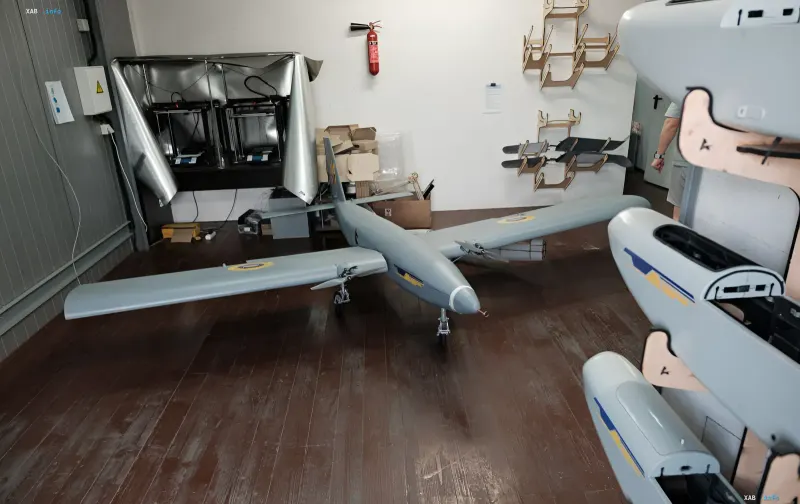
Last week, Ukrainian President Volodymyr Zelenskyy made an ambitious statement: the country has reached production volumes of technological weaponry capable of surpassing Russia's capabilities. However, market experts and representatives of the defense industry (DI) provide a more detailed picture, pointing to significant differences between "technological niches" and "industrial power".
Enemy Scaling and the Threat of Autonomy
The situation on the front dictates strict requirements for production rates. Expert Fedirko, in a comment to RBC-Ukraine, noted that Russia is already producing millions of drones and demonstrating rapid scaling. According to Ukrainian military intelligence, by 2026, the Russian Federation plans to release 7.3 million FPV drones and 7.8 million warheads for unmanned systems. Additionally, the production of long-range strike vehicles and drones of the "Shahed" type is actively increasing.
Particular concern is caused by the qualitative transformation of the enemy's weaponry. The Armed Forces of Ukraine (AFU) are recording the appearance of "Shahed-like" drones without antennas and external control. This indicates that Russia is approaching full autonomy for such systems. After crossing the border, such drones are capable of independently identifying targets and attacking them, which is a serious signal of escalation.
Industrial Heritage and Resource Gap
A comparison of the parties' capabilities shows that Ukraine cannot simply "outnumber" Russia in quantity across all types of weapons. As Fedirko emphasized, in classical heavy industry, Russia retains greater resources, old stocks, and significant inertia in its defense industry.
A representative of Phantom Defense confirmed that Ukraine has not yet caught up with Russia in the ability to scale production. Russia possesses a significant advantage in its industrial base, territory, human resources, as well as the legacy of the Soviet scientific and technical school, which it continues to develop.
Technological Niches as Ukraine's Advantage
Despite the industrial gap, Ukraine has a chance for leadership in specific segments. According to the CEO of the Ukrainian Council of Arms Dealers, an advantage can be achieved in the following areas:
- FPV drones and interceptor drones;
- maritime unmanned vehicles;
- EW systems and deep strike capabilities;
- autonomous systems.
Here, the decisive role is played not only by quantity but also by the speed of adaptation, the quality of engineering solutions, and the ability to quickly change the product in response to frontline tasks.
The Model of Asymmetric Response
Specialists from Phantom Defense point out that Ukraine's strength lies not in playing by Russia's rules, but in an asymmetric response. Over a few years, the country has created entire directions of modern defense technologies from scratch. The main advantages of this model are efficiency and the speed of adaptation to new challenges.
If Ukraine had tried to compete with Russia solely in terms of production scale, it would have been a losing strategy. Instead, the bet is on the speed of innovation, competition between manufacturers, and entrepreneurial initiative. Close ties between the front and developers, supported by international partners, allow for the compensation of limited resources.
Development Prospects
A realistic forecast from experts states: Ukraine's advantage is possible in individual technological niches, but not automatically and not too quickly. This requires stable financing, long-term contracts, fast procurement procedures, access to components, and controlled exports.
With the creation of these conditions, an advantage in individual segments may form within a 1–2 year horizon. Achieving a broader industrial advantage will take more time. As noted by UGV Robotics Director Petr Leontiev, Ukraine is technologically and product-wise ready for a transformation of production, but manufacturers need to be provided with resources to realize this potential.


