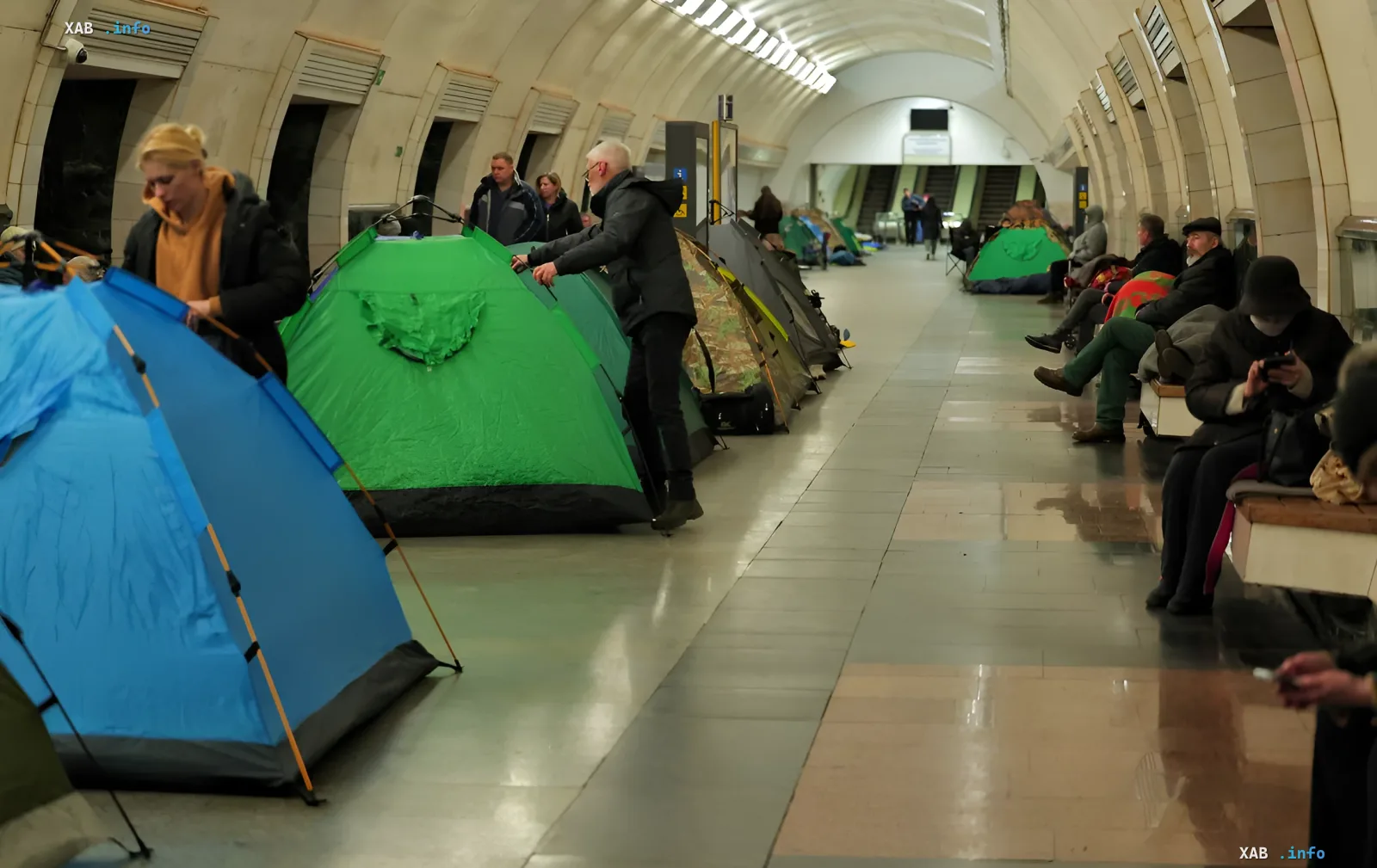
A sharp public debate has erupted in Kyiv following a massive Russian attack on the night of June 2. The trigger for the discussion was the tents that some residents of the capital set up on metro stations to wait out the air raid. Contradictory reviews appeared on social media: some residents complained about the lack of space, while others defended the right to minimal comfort under conditions of prolonged shelling.
Complaints about crowding and lack of space
After the night attack, social media users began writing en masse about how difficult it was to find a place to stay on some metro stations. According to them, tents occupy a significant area where several people could have been accommodated. Some noted that because of this, people had to sit on the floor or squeeze next to strangers.
The problem was particularly acute during peak hours, when metro stations fill up with people seeking shelter. Under such conditions, even a small tent can become the cause of a conflict between passengers.
Defenders of tents: comfort in extreme conditions
At the same time, other users came to the defense of those using tents. In their opinion, families with children and people forced to spend several hours or even the whole night in shelters deserve at least minimal comfort. Tents, they say, help create a sense of personal space and protect from the cold, noise, and stress.
"This is not a luxury, but a necessity," write some users. They emphasize that under conditions of constant alarms and night shelling, people simply cannot afford the luxury of sleeping on the floor in cramped and cold conditions.
Government reaction: inspections and finding a balance
Kyiv City Military Administration press secretary Kateryna Pop told the "Ranok.LIVE" telethon that additional inspections would be conducted following the situation that arose during the last attack. According to her, metro workers help people settle on the stations during alarms and try to organize citizens' stay in shelters as comfortably as possible.
"Regarding the night situation, inspections will be conducted," Pop said. She also noted that due to the status of the metro as an object of critical transport infrastructure, it is difficult to talk about a significant increase in its capacity. However, the Kyiv City Military Administration plans to discuss the situation with the leadership of the Kyiv Metro.
"It is expedient to communicate with the leadership of the Kyiv Metro and investigate the situation with accommodation or introduce optimal restrictions to increase the comfort of all residents," the press secretary noted.
Alternative shelters and digital solutions
The city military administration urges Kyiv residents to use not only the metro. Pop noted on the telethon that an interactive map of shelters is available in the "Kyiv Digital" app, where you can find the nearest safe place near your home or place of residence.
Underground parking lots and responsible business premises are also gradually joining the network of shelters, which, after inspections, can be used to protect the population during air raids. The Kyiv City Military Administration notes that the main criterion for any shelter remains the safety of people, so the issue of expanding the list of such objects requires coordination with SES and civil defense specialists.
Context: scale of the attack and consequences
Recall that on the night of June 2, Russia carried out one of the largest air strikes on Ukraine, using 73 missiles and 656 attack drones. According to the Ukrainian Air Force, among them were eight hypersonic "Zircon" missiles — the largest number of such missiles used simultaneously since the beginning of the full-scale invasion.
It is already known that five people were killed in Kyiv, and another 65 were injured, including three children. Also, due to the shelling, tens of thousands of families were left without electricity, but energy workers have already managed to restore power for most consumers. Rescuers continue to extinguish fires, clear debris, and eliminate the consequences of the strike.
The dispute over tents in the metro is just one of the many problems faced by Kyiv residents under conditions of constant threat. Authorities are looking for a balance between safety, comfort, and the efficient use of limited resources. There is no solution yet, but the dialogue continues.


