
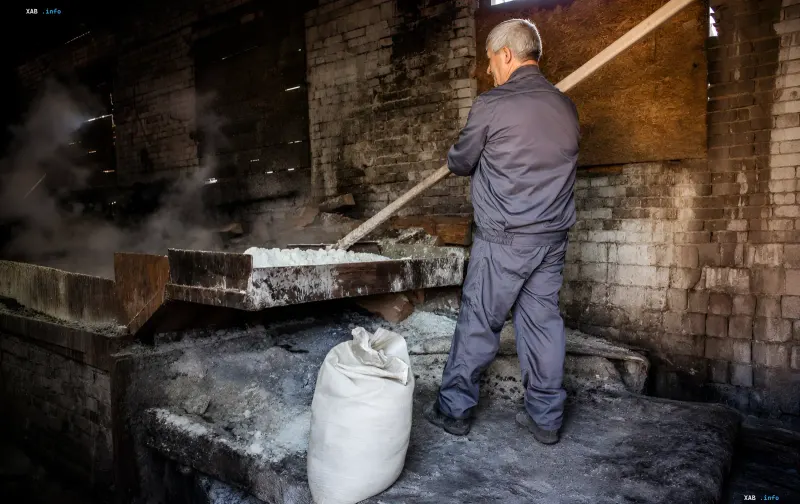
The Ukrainian economy has faced a serious challenge in the field of technical salt mining following the loss of the largest enterprise, "Artemsol," in Soledar. However, the situation began to improve thanks to the resumption of operations at the Tereblia deposit. Despite prolonged corporate conflicts and attempts at raider takeovers, the enterprise has returned to product supply, opening prospects for covering the domestic deficit.
Return to Operation After Conflict
The Tereblia deposit, a strategically important asset, went through a difficult period in 2024–2025. The cause of the work stoppage was a sharp corporate conflict between the owners of the operating company, LLC "Cation Invest." Amidst disagreements, mining was suspended, creating a threat to market stability.
However, by autumn 2025, the enterprise resumed operations. As confirmed by the director of "Cation Invest," Serhiy Kondratiev, supplies of technical salt to Ukrainian companies were launched. Currently, businesses are actively purchasing Tereblia salt, focusing on the 2026–2027 season.
The Battle for the Special Permit
The restoration of operations was not without intrigue and attempts to change control over assets. In November 2025, according to Serhiy Kondratiev, an illegal scenario of leadership change occurred at the enterprise. The directors were replaced by a former deputy of the Pryluky City Council, who, according to Kondratiev, was controlled by co-owner Oksana Omelyanenko. The new manager immediately attempted to sell the special permit for subsoil use to an outside company from Pryluky.
The side of co-owner Ihor Heray (holding a 5% share) and Oksana Omelyanenko (45% via JSC "ZNVKIF Yukon") categorically denies accusations of raiding. They claim that the change of director in November 2025 was a legal reaction to systemic violations by Serhiy Kondratiev, which led to accumulated debts, a halt in mining, and technological risks. In their opinion, the appointment of Oleksandr Prozur was necessary to unblock the enterprise's operations.
Nevertheless, the attempt to alienate the special permit in December 2025 was unsuccessful. The working group of Derzhgeonadra refused to change the user due to the existence of a tax debt and the provision of unreliable data. As a result, Serhiy Kondratiev was reinstated to his position through the anti-raiding commission of the Ministry of Justice, and the re-registration of the special permit by him was blocked.
Economic Potential and Future Plans
The Tereblia deposit possesses colossal reserves: 15.5 million tons in category C1 and more than 500 million tons in category C2. The uniqueness of the local salt lies in its high efficiency. The melting capacity indicator of Tereblia salt is 16 units, meaning: one kilogram of salt can melt 16 kilograms of ice. For comparison, this indicator for imported Egyptian salt is 5. This allows Tereblia salt to be used three times more economically.
In 2026, the enterprise plans to reach its design capacity of 450,000 tons per year. This event will be a turning point, as it will allow fully closing the deficit of technical salt in Ukraine and significantly covering the demand for food products.
Context: Loss of "Artemsol" and Growth of Imports
The return of the Tereblia deposit to operation is of critical importance against the backdrop of the loss of the country's largest salt mining enterprise — "Artemsol" in Soledar in the spring of 2022. "Artemsol's" share of the market was about 90%, and its capacity exceeded 7 million tons per year.
After the occupation of the region, Ukraine was forced to sharply increase imports. Already in 2022, salt purchases abroad increased almost threefold — to 284,000 tons, and expenses for them jumped sevenfold. The full restoration of the Tereblia deposit will allow the country to reduce dependence on foreign suppliers and adapt to new economic realities.


