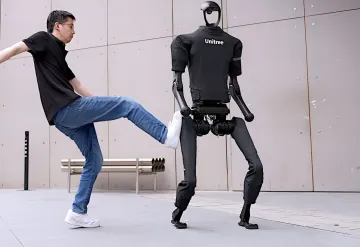
In August 2026, the world continues to witness a technological boom associated with humanoid robots. Companies, particularly Chinese giants, are showcasing impressive prototypes capable of performing complex tricks and mimicking human movements. However, behind the facade of technological enthusiasm lies a reality far removed from the total automation of production. Despite the active growth in the supply of serial models, their practical application in industry remains at the level of pilot projects rather than mass adoption.
The Gap Between Forecasts and Real Demand
Analysts and market experts provide diametrically opposite assessments of the current situation. According to forecasts by Smart Analytics Global, global shipments of humanoid robots by the end of 2026 will reach 60,000 units, growing to half a million by the end of the decade. However, representatives of Gasgoo Automotive Research hold a more optimistic estimate, predicting shipments of 100,000 units already this year. At the same time, according to Gasgoo data, truly mass production and the scaling of successful pilot projects will not begin until the second half of 2027.
The key problem lies in the structure of demand. A significant portion of robots coming off the assembly line does not enter industrial workshops to perform routine tasks. The surge in demand is driven by the manufacturers themselves, purchasing equipment for R&D and training, as well as companies striving to maintain their image as innovative leaders. Furthermore, a substantial volume of procurement falls to software developers who need "hardware" to test algorithms.
The Paradox of Industrial Implementation
Statistics on robot usage in 2026 demonstrate a striking imbalance. According to expert estimates, only 15% of supplied humanoid robots find real application in industry. Meanwhile, 35% of devices are used for demonstration and entertainment purposes, and another 20% go towards research needs and software development. This creates a paradoxical situation: sociological surveys point to the industrial sector as the main target of demand, but in practice, this segment remains the smallest in volume.
In the production environment, robots are predominantly at the stage of training and adaptation. For a robot to work effectively in a specific environment, huge volumes of data and specialized software are required, which are currently in active development. Training for even the simplest operations takes a lot of time and requires significant human involvement. The data used for training is often non-standard and heterogeneous, complicating the work of specialists. Moreover, companies conduct this work in a fragmented manner, rarely exchanging experience, which forces them to start from scratch every time.
Technical Barriers and Economic Feasibility
Scaling the application of robots in production faces serious technical obstacles. For stable operation, robots must possess high predictability; however, in practice, they often lag behind living workers in reaction time, making their integration into assembly lines difficult. Issues regarding the precision of manipulations also remain relevant. Robot developers often lack a deep understanding of industrial processes, while customers, in turn, poorly represent the technical limitations of modern machines. Adaptation takes a lot of time and remains an expensive procedure.
The economic factor also plays a decisive role. For now, truly effective humanoid robots remain expensive. Lowering the price threshold is possible only with a transition to mass production, which requires time and colossal investments. According to forecasts, the cost of an industrial robot will drop to an acceptable range of $30,000–$40,000 only by 2030. Without a clear understanding of the payback period, customer interest in purchasing equipment remains limited.
Contradictory Data
There are significant discrepancies among analysts regarding market growth rates. Smart Analytics Global forecasts conservative growth to 60,000 units in 2026, while Gasgoo Automotive Research cites a figure of 100,000 units for the current year. Furthermore, there are discrepancies in the definition of "mass adoption." For some experts, this is the start of serial shipments; for others, it is the actual replacement of human labor on the assembly line. So far, the only consensus is that a full-fledged industrial revolution involving humanoids will not begin until the second half of 2027, and mass availability at affordable prices will shift to 2030.
The Problem of Safety and Collaboration
One of the main barriers to mass adoption remains the issue of industrial safety. As long as robots work side by side with people, it is necessary to ensure the protection of personnel from accidental harmful effects. In an unmanned environment, this problem would be less acute, but the process of implementation in industry cannot be immediately switched to a phase of full automation without people. This requires additional funds and time to develop safety systems, which further delays the payback period and commercial attractiveness of such solutions.