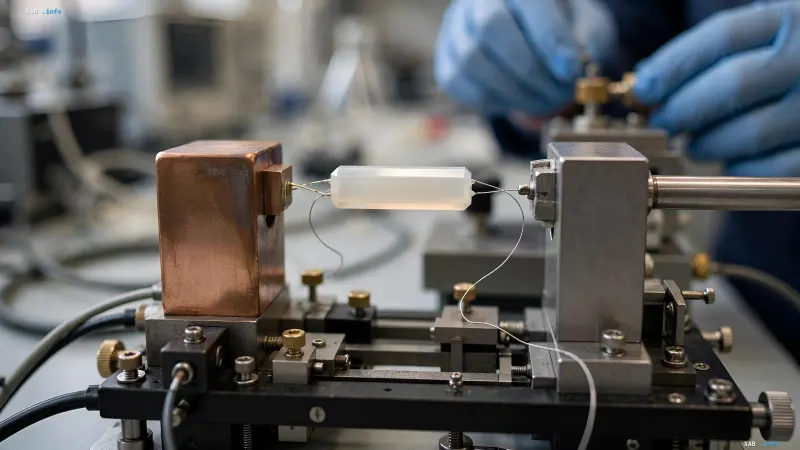
South Korean researchers have introduced a solid-state thermal transistor — a device in which heat transfer is regulated directly by electrical voltage, without a compressor, refrigerant, or any moving parts. The design is based on a bulk single crystal of barium titanate (BaTiO₃): under the influence of an electric field, its thermal conductivity changes in the range from 2.7 to 4.3 W/(m·K). Essentially, the electrical signal directly alters the material's ability to conduct heat, which fundamentally distinguishes this approach from conventional cooling and heating systems where heat is transferred by a refrigerant or a mechanical pump.
How the Effect Works: Domains and Phonons
The physical mechanism is related to ferroelectric domains — regions of the crystal where electrical polarization is oriented differently. When the applied voltage changes, these domains reorient, altering the conditions for heat transfer within the material. Heat transfer itself is carried out by phonons — collective vibrations of the crystal lattice atoms; they propagate with different efficiencies in different domains, so domain redistribution allows for the smooth tuning of thermal conductivity. Importantly, unlike a conventional thermal switch that has two fixed modes, the transistor provides continuous adjustment between them.
Laboratory Verification: House Model and Body Mockup
In the laboratory, the device was tested in a system featuring a miniature model of a house and a heated human body mockup. When heat retention was required, the electric field switched the crystal into a thermal insulation mode and raised the baseline temperature of the mockup by approximately 0.6 °C. When heat dissipation was needed, the device shifted to an enhanced heat transfer mode. For comparison, a commercial Peltier element — a semiconductor module that heats one side and cools the other when current passes through it — provided a comparable temperature change but consumed significantly more energy.
Energy Consumption and Main Limitation
In a mode with two switchings per day, the average power consumption of the thermal transistor was 33 µW/cm². To perform the same task, a compressor heat pump required approximately 9 times more energy. At the same time, the authors emphasize an important limitation: the device does not transfer heat against an existing temperature gradient like a heat pump does, but merely regulates the flow from a hotter region to a cooler one. Therefore, it does not replace refrigeration units, but can work alongside them to reduce the load on the system.
Application Prospects and Stability
Potential application areas include regulating heat exchange in buildings, cooling batteries and power electronics, as well as spacecraft thermal control systems. The authors also tested the durability of the crystal: after 100,000 electrical switching cycles, the change in thermal conductivity remained at around 2%, and the switching ratio changed by less than 1%. The work shows that an electrical signal can control not only current in electronic components, but also heat transfer directly within a solid material; the next step will be the development of devices capable of utilizing this effect in real heating, cooling, and heat dissipation systems.