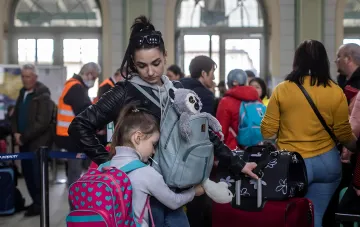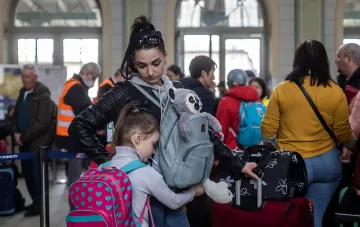
Although temporary protection for Ukrainian citizens in the European Union has been extended until March 2028, Brussels has clearly defined the group of people who may be expelled from EU territory on a priority basis. RBC-Ukraine reports this, citing a document from the Council of the European Union. As of the end of May 2026, more than 4.3 million people who left Ukraine due to the war were enjoying temporary protection status in EU countries. However, as it turns out, holding this status is not an absolute "guarantee" against forced expulsion for everyone without exception.
Who will be expelled first
The EU Council identified three categories of citizens subject to priority expulsion. The first — individuals who entered the Schengen Area illegally, that is, who bypassed official border crossing points and did not undergo border control procedures. The second category — citizens who committed a criminal offense on the territory of an EU member state or who pose a direct threat to public order and security. The third — those who entered the European Union using forged documents or who deliberately provided false information about their identity when applying for the status.
What "deportation" actually means
It is important to understand that forced expulsion from the EU does not necessarily mean a return to Ukraine. Under current procedures, offenders are most often sent to third-country hubs on a general basis, rather than to their country of origin. In addition to the fact of expulsion itself, an entry ban on the territory of the European Union for a specified period is imposed on such a person. The corresponding information is entered into the Schengen Information System (SIS), which makes obtaining a visa or status again virtually impossible during the ban period.
Context: extension of protection and internal EU disagreements
Temporary protection for Ukrainians in the European Union has been extended until March 2028, the result of months of negotiations between member states. However, the conditions of stay for Ukrainian refugees in the EU are not being changed for the first time. As early as June 2026, RBC-Ukraine reported that a number of member states were pushing for changes that would allow some of the displaced persons to be returned home. The EU then split over the issue of restrictions for Ukrainian men of conscription age: not all states supported the idea of canceling temporary protection for them. Later, Brussels already changed the conditions for obtaining the status — Ukrainians leaving the country are now required to have a border crossing stamp in their passport, otherwise problems may arise with the issuance or extension of temporary protection.
Contradictory data
No significant discrepancies in figures or dates were found in the provided sources. The only nuance: the source cites "the end of May 2026" as the point at which the figure of 4.3 million people was recorded, whereas the current publication date is August 2026. Exact data for the current moment are not provided in the material, which may mean a slight deviation of the real figure from the one stated. In addition, the wording "deportation" in the source's headline somewhat simplifies the procedure: this is not a classic deportation to the country of origin, but an expulsion accompanied by an entry ban, which is a procedurally different mechanism.
Thus, the extension of temporary protection until 2028 does not cancel the basic rules of the Schengen acquis: illegal border crossing, criminal offenses, and document forgery remain unconditional grounds for expulsion regardless of refugee status. For the millions of Ukrainians legally residing in the EU, this does not create a direct threat, but it underscores that temporary protection is not a permanent and unconditional status, but a tool with clearly defined exceptions.