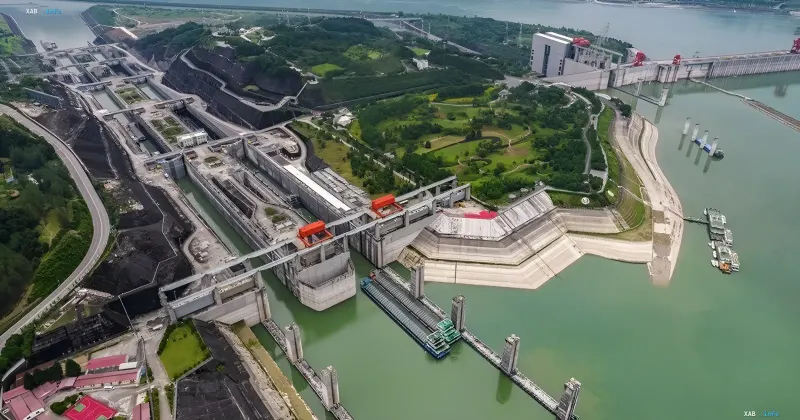
On the banks of the Yangtze River in China's Hubei province stands a giant that has not only transformed the region's landscape but also influenced the physical structure of our planet. The Three Gorges Dam is the world's largest hydroelectric power station by installed capacity, and its construction became one of the most ambitious projects in human history.
From Sun Yat-sen's Idea to a Global Megaproject
The history of this grand structure dates back to the early 20th century. The idea of utilizing the hydroelectric potential of the Yangtze was first voiced by leader Sun Yat-sen as early as 1919. However, decades were required for research and preparation. Actual construction began only in 1994 and lasted nearly 18 years, concluding in 2012. The total investment in the project is estimated at $37 billion USD.
The project's goals were massive: not only electricity generation but also control over destructive floods and increasing the capacity of waterways to boost trade between western and eastern China.
Scales Hard to Comprehend
The Three Gorges Dam represents one of the largest reinforced concrete structures ever created by man. Its length is 2,335 meters, and its height reaches 181 meters. About 28 million cubic meters of concrete and 463,000 tons of steel were used to build the giant. For comparison: that amount of metal would be enough to build 63 Eiffel Towers.
Behind the dam, a reservoir stretching about 600 km was formed. Its total capacity is nearly 39.3 billion cubic meters of water, of which more than 22 billion cubic meters are allocated specifically for flood control. The surface area of the reservoir exceeds 1,000 square kilometers, making it one of the largest artificial lakes in the world.
Energy and Logistics
The power station is equipped with 34 generating units with a total capacity of 22,500 MW. On average, it generates 0.54 TWh of electricity per day. This volume is sufficient to supply electricity to 5.4 million households for an entire month.
Besides energy, the project radically changed the region's logistics. A five-level lock system and modern ship lifts allow large vessels to pass the dam unimpeded, stimulating economic development and trade.
The Price of Progress: Resettling Millions
Implementing such a project required colossal social efforts. To flood the territory for the reservoir, about 1,350 villages and towns were relocated. More than 1.2 million people were forced to leave their homes and find new residences. In response, new urban districts, transport systems, schools, and hospitals were built, giving a powerful boost to the infrastructure development of the reservoir area.
Impact on the Earth's Rotation
The Three Gorges Dam impresses not only with its engineering characteristics but also with the fact that it became a subject of study for NASA scientists. Researchers from the Goddard Space Flight Center concluded that the accumulation of such a huge volume of water changed the mass distribution within the Earth.
According to calculations, the redistribution of mass led to a shift in the Earth's axis of rotation by approximately 2 centimeters (3/4 of an inch) and an increase in the length of the day by 0.06 microseconds. Although these changes are imperceptible to humans and do not affect daily life, they confirm the ability of megaprojects to influence the planet's microbalance.
In a 2010 study published in the journal Geophysical Research Letters, experts called for a careful assessment of geophysical consequences before implementing such projects. More than a decade after operation began, the Three Gorges Dam remains a symbol of possibilities in planning and construction, staying at the top among the world's hydroelectric power stations.