
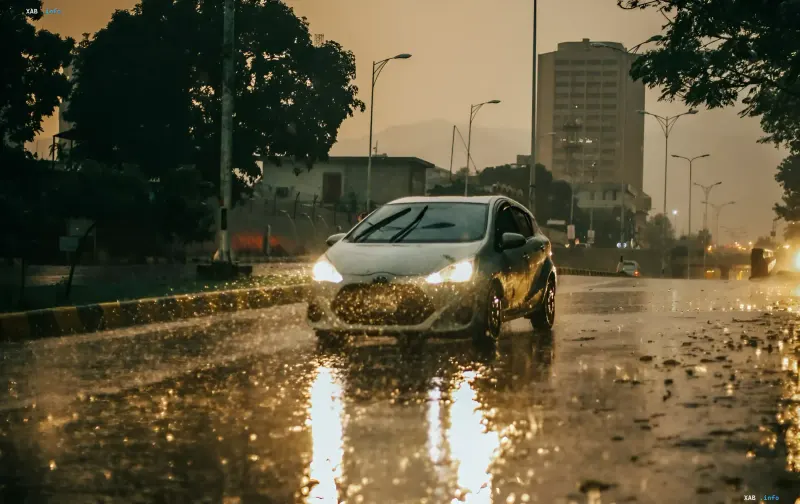
Most drivers perceive rain as a minor inconvenience rather than a genuine risk factor. Yet it is precisely in wet conditions that a significant share of road accidents occurs, often for reasons that are far from obvious to the average motorist. Wet asphalt is not just 'a bit slippery'. Depending on the intensity of the precipitation, the condition of the road surface, and the technical characteristics of the vehicle, the road can turn into a surface with a friction coefficient comparable to ice. And all of this without any warning from the road infrastructure.
'Liquid Soap': the Invisible Film on Slightly Wet Asphalt
The first and, perhaps, most insidious factor is the so-called 'invisible but extremely slippery film' on slightly dampened asphalt. Auto expert Evgeny Mudziri, founder of the Autogeek project, compares it to genuine 'liquid soap'. Until the downpour washes the accumulated dirt, oil, and dust off the road, a vehicle's braking distance can be even longer than during a heavy downpour. The paradox is that it is precisely at this moment — when the rain has just started or is falling as a light drizzle — that the driver tends to relax, thinking 'the rain isn't heavy, I can drive as usual'. In reality, the friction coefficient during this period is at its minimum.
On the other hand, during prolonged rain the situation changes: the washed asphalt acquires a friction coefficient very close to that of a dry surface. But here a different threat arises — hydroplaning, which we will examine below. Thus, on the same road at different moments of the rain, the degree of 'slipperiness' can differ radically, and a responsible driver needs not merely to understand that they are driving on a wet surface, but to assess the specific condition of the asphalt at that very moment.
Hydroplaning: When the Car 'Floats' and Loses Control
Hydroplaning is a deadly dangerous effect that, in the rain, is created less by nature than by the driver themselves. The essence of the phenomenon is simple: when driving on wet asphalt, each wheel gathers a wedge of water in front of it. Under normal conditions, the water is channeled to the sides through the grooves of the tire tread from the contact patch with the road. However, when the vehicle moves too fast, the water cannot be drained in time, the wheel fails to push through the water layer, and ultimately floats up — losing contact with the asphalt. Along with the contact, controllability disappears.
It is critically important to understand: in hydroplaning mode, braking no longer helps. The vehicle has time to drift sideways and leave the road before the braking wheels squeeze the water out and re-establish contact with the road. Predicting the moment when hydroplaning occurs is extremely difficult — it arises without warning. The exact speed at which a particular car will enter this mode cannot be named: the factors vary from the model and condition of the tires to the rutting of the road and the volume of water on the surface.
Evgeny Mudziri emphasizes the mechanical nature of protection against hydroplaning: 'Preventing hydroplaning is purely the mechanical work of the tread grooves, which must channel away liters of water every second.' The expert draws attention to an important nuance: if the law allows a minimum tread depth of 1.6 mm, then in practice the critical minimum for safe driving in the rain is at least 3–4 mm. 'Bald' tires lose contact with the road already at a speed of 60–70 km/h, turning the car into uncontrollable bobsleds. The conclusion for the driver is unambiguous: familiar 'summer' speeds and autumn weather are incompatible things.
'Didn't See It': the Problem of Visibility and Cabin Microclimate
A large share of accidents in rainy weather happens for a mundane reason: the driver did not see an obstacle on the road. And this is insidious precisely because in a properly maintained modern car, visibility in the rain usually remains acceptable — until that very moment of sudden deterioration. The windows fog up, the wiper blades leave a micro-film of water that blinds you in the headlights of oncoming cars, and the windshield is covered with ripples from unevenly wiped moisture.
'Most accidents in the rain happen not because of technical malfunctions, but because of a simple "didn't see it"', Mudziri reminds us. The expert advises that before heading out into bad weather, you should make sure the cabin is warmed up, and also learn how to switch on the fast windshield defrost and the maximum wiper speed in your particular car. 'Yes, visibility in the rain is affected first and foremost by the microclimate inside the cabin', he notes. A basic but often ignored tip: always turn on the air conditioning or climate control even in cool weather, since it instantly dries the air inside the cabin and prevents fogging. Worn wiper blades are another hidden risk factor: they leave a thin film of water on the glass, which in nighttime or twilight driving turns the light of oncoming cars' headlights into a blinding glare.
Practical Recommendations for Drivers in Rainy Weather
The summary of expert recommendations boils down to several specific actions. First, reduce your speed to a level at which you retain full control over the vehicle — especially at the start of the rain, when the asphalt is most slippery because of the 'liquid soap'. Second, regularly check the condition of your tires: a tread depth of less than 3–4 mm is a reason for urgent replacement, not for 'driving a bit longer until spring'. Third, before heading out into bad weather, make sure the wipers are in working order, warm up the cabin, and turn on the climate control to prevent fogging. Fourth, increase the distance to the vehicle ahead and avoid sharp maneuvers, since on a wet surface the car's response to the steering wheel and brakes becomes less predictable. And finally, remember that hydroplaning has no 'warning signal' — the only protection against it is an adequate speed and properly functioning tires.


