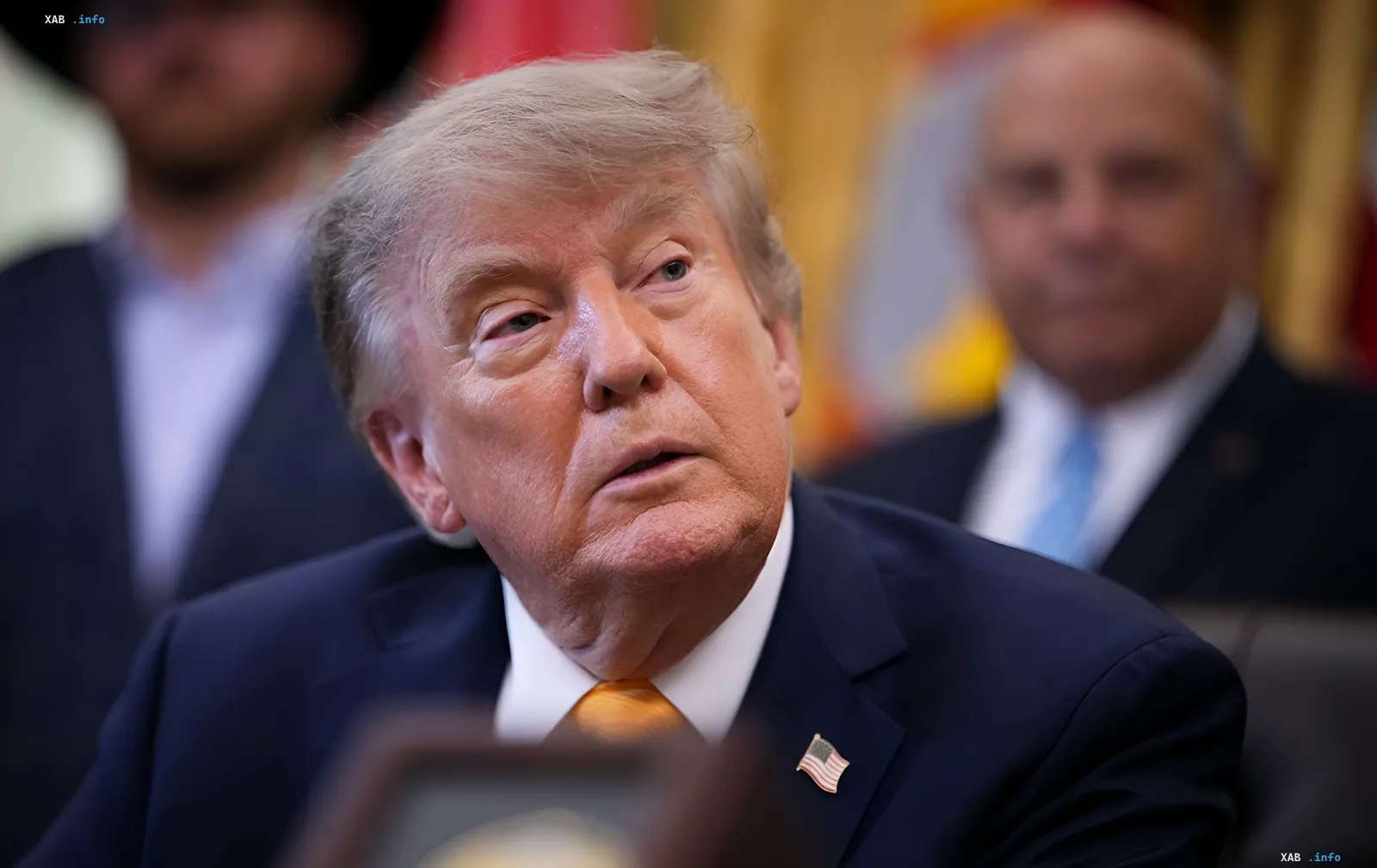
US President Donald Trump has once again drawn public attention to his appearance — in recent public photographs, his signature golden-blond hairstyle looks noticeably darker and richer than in previous months. Observers and media outlets almost instantly noted the change in shade, yet a professional assessment of the situation turned out to be far more nuanced than it might appear at first glance. Hairdresser Ruslana Bela, commenting on the American leader's new image for the outlet Wave RBC.UA, emphasized that the key aspect here is not so much a possible change in color as how the hairstyle as a whole works with the visual perception of hair density.
The hairstyle as a 'camouflage system'
According to Ruslana Bela, Trump has had noticeable thinning of hair in the crown area for many years, and it is precisely why his signature style — with its characteristic length, direction, and complex shape — effectively serves the function of visual camouflage. The hair is styled and swept in such a way as to cover areas of reduced density as much as possible. 'As a hairdresser, what I see here first is not simply a change of hairstyle, but work with the visual density of the hair,' the stylist explained. In her assessment, the president's hairstyle is a thought-out system in which length, styling direction, shape, and possibly color correction work in tandem to create the impression of greater volume where there is objectively less of it.
Darker in photos — does that mean a dye job?
The expert separately addressed the question of the shade change. Bela stated plainly that based on photographs alone it is impossible to confidently assert that Trump actually dyed his hair: lighting, camera settings, and subsequent image processing all significantly affect the perception of color. Thus, claims of a 'new color' remain, for now, a visual observation rather than a confirmed fact. That said, the stylist acknowledged that if coloring did take place, a darker or richer shade could serve as a classic coloristic technique for giving the hair visual density. 'Color can change our perception of the mass of hair, even though it does not, of course, add any real density,' she noted.
Skepticism toward hair transplants and the beauty industry's 'magic button'
In the course of her commentary, Ruslana Bela also shared her personal professional view on hair transplants — a procedure that today's beauty industry often presents as a universal solution to the problem of hair loss. The stylist stated that she is skeptical of such marketing framing: 'It is an expensive surgical procedure that is often presented almost as a guaranteed return of one's former hair.' At the same time, she clarified that she does not consider transplants ineffective — with appropriate indications, they can yield good results. Her skepticism is directed not at the surgery itself but at the inflated expectations created by advertising: 'As a professional, what interests me is a result the person can comfortably wear for years, not an 'after' shot in a photograph.'
Contradictory data
The central contradiction in the discussion of Trump's new look lies in the gap between visual observation and confirmed fact. On the one hand, in public photographs the president's hair objectively looks darker and richer than in photos from previous months, and this is noticed by both media and the general public. On the other hand, neither Trump himself nor his entourage has confirmed that any coloring was carried out. Hairdresser Ruslana Bela stated plainly that without accounting for shooting conditions — lighting, white balance, camera behavior, and post-processing — it is impossible to reliably distinguish a real shift in pigment from an optical effect. Thus, at present there are two equally valid versions: either the president did adjust his shade as part of a visual camouflage strategy, or the darker tone is an artifact of a particular shooting session. Until further confirmation emerges, both interpretations remain in play.
Context: Trump's hairstyle — a persistent object of public attention
It is worth noting that the current discussion is not a one-off episode. As far back as August 2026, the American leader's hair became the subject of active conversation after he appeared on camera with a fuller-looking style. Now the discussion has added the element of a shade change. For a political leader whose image is carefully curated, every detail of appearance — from cut length to hair tone — can carry a communicative message. The professional analysis conducted by Ruslana Bela allows one to view Trump's hairstyle not as a random style but as a deliberate system of visual perception management, in which every element — from styling direction to possible color correction — is subordinated to a single task: to create a lasting impression of density and volume.


