

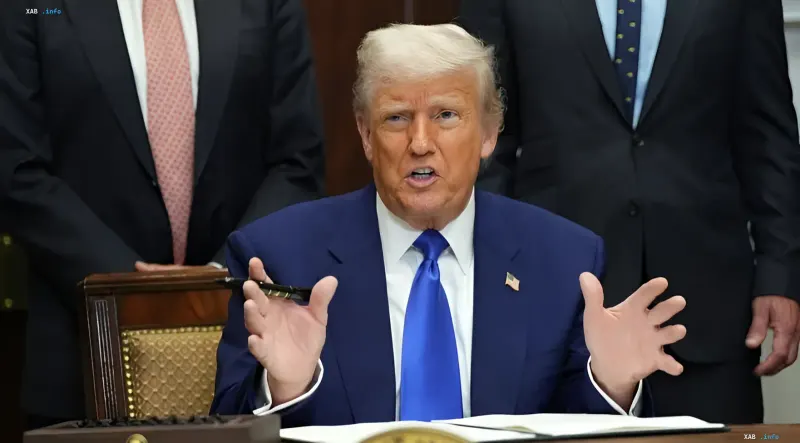
Aboard the presidential aircraft Air Force One, returning from the NATO summit in Ankara, Donald Trump made a bold statement that immediately sparked a storm of reaction in diplomatic circles. The American leader claimed that Spain had agreed to a "complete concession" and was ready to meet Washington's demands for a significant increase in defense spending. According to Trump, Madrid reached this decision following public threats from the White House to impose a trade embargo and suspend official visits.
However, behind the scenes of this victory, declared by the US President, lies a complex web of legal restrictions and economic interdependence that makes the implementation of such threats extremely problematic.
From "bad partner" to "generosity": escalation of the conflict
The chronology of events shows that the public conflict between the US administration and the Spanish government intensified as early as July 8, 2026, on the sidelines of the summit in Turkey. In the presence of NATO Secretary General Mark Rutte, Trump called Spain a "bad partner" and gave a direct order to Treasury Secretary Scott Bessent to prepare the regulatory framework for blocking commercial ties.
The reason for Washington's dissatisfaction was twofold. First, the left-centrist government of Pedro Sánchez refused to commit to allocating 5% of GDP to defense by 2035. Second, Madrid took a sovereign stance in the Middle East crisis: Spain closed its airspace to US aircraft participating in operations against Iran and limited the use of Rota and Morón bases for offensive actions.
Trump, however, stated that economic pressure had worked. He noted that "Spain showed great generosity," although he did not disclose legal details or specific amounts of the proposed payments.
Madrid's reaction: friendliness against pressure
Official representatives of Spain categorically disagree with the White House's version. Prime Minister Pedro Sánchez, at the closing press conference in Ankara, characterized the dialogue with Trump as "quite friendly." He emphasized that the country's defense budget is already showing steady growth: in 2026, it reached 2% of GDP (€35.41 billion), which is three times higher than the 2018 figures (€11.17 billion).
Health Minister Mónica García called the American president's rhetoric an attempt to replace classic diplomacy with pressure tactics, reminding everyone of the state's sovereign status.
Legal shield: why an embargo is impossible
The main obstacle to implementing Trump's threats lies in legislation. Legal advisors in Washington point out that imposing a total embargo based on the International Emergency Economic Powers Act (IEEPA) is unlikely. This requires a declaration of a state of emergency and proof of an "unusual and extraordinary threat" to national security, which is difficult to establish in the case of a NATO ally.
Furthermore, there is a hard barrier in the form of European Union regulations. According to Article 207 of the Treaty on the Functioning of the EU, trade policy falls under the exclusive competence of the European Commission. This means that sanctions against one EU country are legally equivalent to restrictions against the entire bloc. Spain cannot conduct separate negotiations on changing tariffs without a mandate from Brussels.
Economic risks for the US
In addition to legal complexities, the Trump administration faces economic reality. Spain remains a major investment destination for the US with accumulated capital exceeding €116 billion. If Washington decides to use sectoral tariff mechanisms (e.g., Section 301), this will inevitably provoke a mirror response from the EU, which will hit the interests of American investors.
The trade balance for 2025 also speaks to the close link between the economies:
- US exports to Spain amounted to $26.6 billion.
- US imports from Spain — $21.35 billion (mainly agricultural and machinery products).
Thus, the loud statements on board Air Force One clash with the hard reality of institutional barriers, where the political will of one leader cannot single-handedly rewrite the rules of global trade.


