
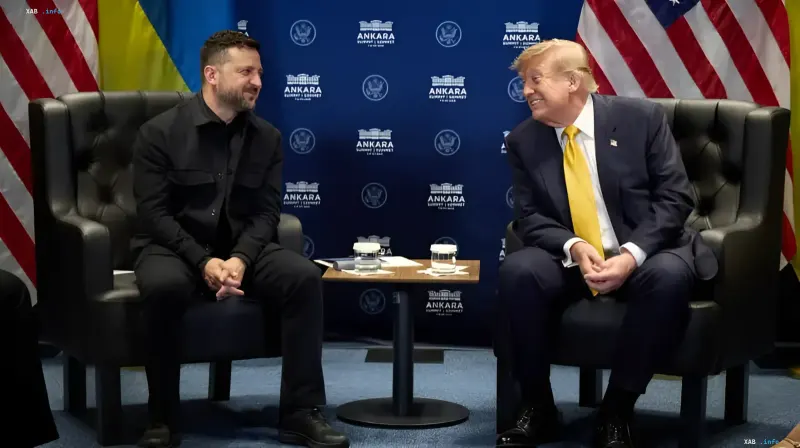
The NATO summit in Ankara, intended to unite alliance leaders to discuss global threats, became the stage for a series of extraordinary incidents. The center of attention was US President Donald Trump, whose public slips during protocol events led to a factual distortion of diplomatic reality. The situation, which began with the misidentification of a counterpart, escalated into a curiosity involving Washington's key allies.
"President Putin" instead of Zelenskyy
The incident occurred at a moment classic for diplomatic protocols — the joint appearance of leaders before the press. During a meeting with Ukrainian President Volodymyr Zelenskyy, Donald Trump, addressing the media representatives, made a fundamental error. Instead of introducing his Ukrainian colleague, the American leader pointed to Zelenskyy and asked journalists: "Do you have any questions for President Putin?".
The situation required an immediate correction. Following remarks from the reporters present, the White House head steered the dialogue into an ironic direction. He clarified: "Do you have any questions for President Putin, and not for Zelenskyy? What would you like to ask him? Because I can ask him that question". Despite the attempt to ease the tension, the factual error was recorded.
"Islamic Republic of Japan": a confusion of concepts
The second, no less loud incident, occurred during discussions on the sidelines of the summit dedicated to the security of maritime communications. Commenting on the interception of air attack means, Trump used a definition that has no analogues on the geopolitical map of the world. "The Islamic Republic of Japan fired 111 missiles at us," the US President declared.
Analysts and specialized media resources, including the Kyodo News agency, promptly analyzed the statement. Official Tokyo is a strategic ally of Washington based on the 1960 Treaty of Mutual Cooperation and Security. The probable cause of the misinformation was the confusion of the characteristics of the Islamic Republic of Iran and incidents surrounding the American aircraft carrier USS Abraham Lincoln (CVN-72). The verbal substitution of concepts led to the creation of a fictional enemy image that does not exist in reality.
Diplomatic vacuum and consequences
At the current moment, official comments from the US Department of State, the Office of the President of Ukraine, and the Ministry of Foreign Affairs of Japan regarding these statements have not been received. The White House protocol services have also not published explanations of the transcripts of the speeches.
Diplomatic practice classifies such incidents as spontaneous speech errors that do not reflect a change in the vectors of state policy. Washington maintains all international agreements in force with both the Ukrainian side and Japan. However, in the era of instant information transmission, even oral statements on the sidelines of summits carry weight, requiring diplomats to make additional efforts to clarify the actual position of the countries.


