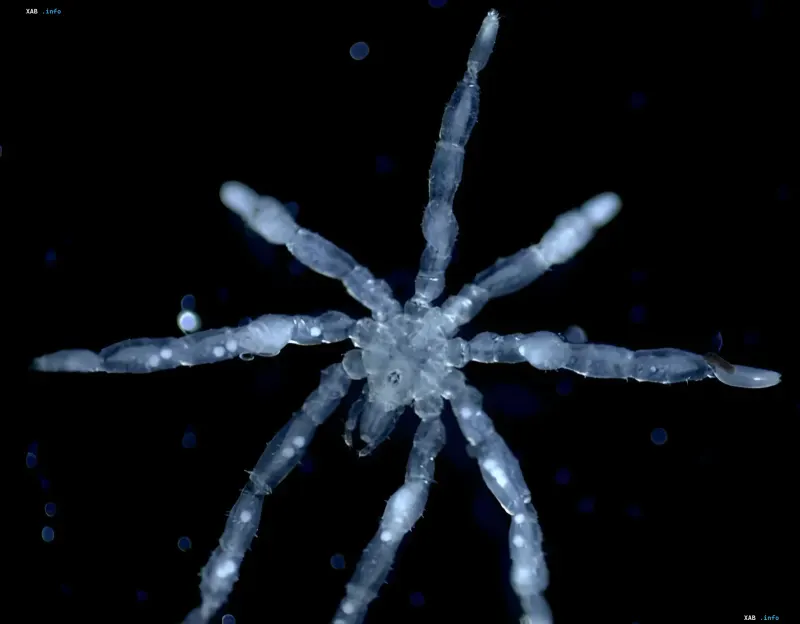
Canadian researchers have made a remarkable discovery in the waters of the Salish Sea, identifying two previously unknown species of sea spiders. Specimens of these unusual creatures were collected during deep-water dives up to 18 meters deep conducted between September 2023 and August 2024. This finding significantly expands our understanding of the biodiversity in the coastal waters between the Canadian province of British Columbia and the American state of Washington.
Peculiarities of the New Species and Survival Mechanisms
One of the discovered species has been named Callipallene pilosuspedes. Its main anatomical feature is the dense growth of long, curved spines on the underside of its limbs. The Latin name reflects this trait: 'pilosus' means hairy, and 'pedes' means foot. Scientists discovered that these animals use specialized limbs to clean their bodies by wrapping them around their legs and utilizing comb-like spines. Such a unique grooming mechanism has not been previously recorded in most similar marine arthropods.
The second newly found species was named Tanystylum kiixin. Unlike its relative, this organism has less flexible ovigerous limbs, severely limiting its self-cleaning ability. As a result, many specimens of Tanystylum kiixin were found densely covered with parasitic organisms. The species name derives from a local indigenous cultural term denoting the sound of waves crashing against the shore in the area of an ancient settlement.
Origin and Biology of Sea Spiders
Despite their common name, sea spiders are not true spiders in the traditional biological sense. They belong to a distinct group of marine arthropods distantly related to modern spiders, scorpions, and horseshoe crabs. The evolutionary history of these fascinating creatures spans approximately 500 million years, during which they have adapted to a wide variety of ocean floor habitats.
The anatomy of sea spiders is striking in its specificity: due to their miniature body size, parts of their internal organs, including elements of the digestive and reproductive systems, extend directly inside their long legs. Furthermore, in many species, males take on the responsibility of carrying eggs on specialized limbs until the offspring hatch. The discovery of these new species in the Salish Sea highlights the urgent need for further study and protection of vulnerable coastal ecosystems against anthropogenic impacts.
Controversial Data
During the analysis of scientific literature and primary sources, researchers encountered certain discrepancies in estimating the total number of previously known species in the Salish region. Some ecological reports indicate that only about 17 species of sea spiders had been officially recorded in the area prior to this, while other expert databases suggest a broader diversity of undiscovered cryptic species. Nevertheless, all scientific groups agree that the level of knowledge regarding this group of invertebrates remains extremely low against the backdrop of a changing climate.