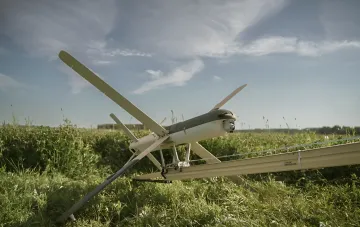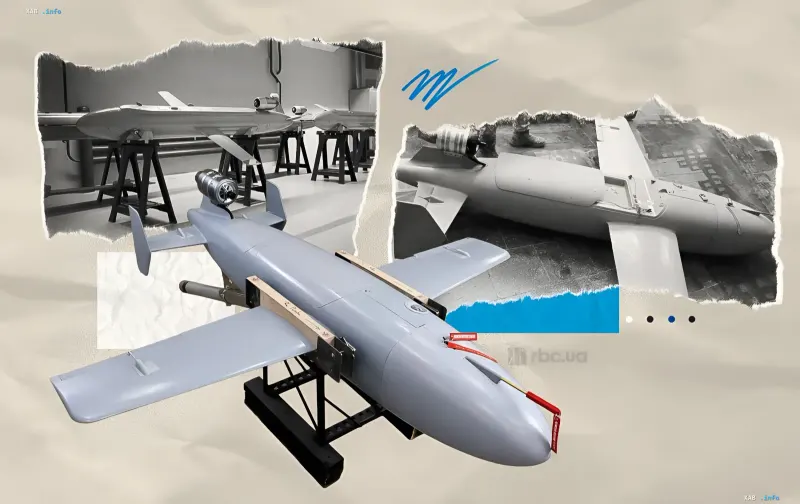
Ukraine is steadily intensifying strikes on military targets deep in the enemy's rear, and one of the tools in this direction is becoming its own jet-powered unmanned aerial vehicles. At the center of this logic is the «Bars» system — a jet-powered UAV that its developer describes not as a single missile, but as a modular platform capable of carrying a warhead and operating at extreme ranges. In an interview with RBC-Ukraine (the source's name is not disclosed for security reasons), the engineering team explained how the project grew from a volunteer initiative into a series with dozens of iterations, and what the fundamental difference is between a jet-powered drone and a conventional missile.
From a volunteer initiative to a serial platform
According to the developer, work on «Bars» began in 2023. A team of enthusiasts, including specialists in aviation and model aircraft, initially acted as volunteers and aimed for maximum coordination with the military. It was precisely through extensive contact with the military that the team received a recurring request: to provide the Armed Forces of Ukraine with a means to "respond in kind" and destroy targets not only on its own territory but also on enemy territory. The appearance of the device, which the developer acknowledges resembles a "little airplane," is a direct consequence of the model-aircraft background of part of the team.
Modular architecture and three application profiles
The key idea behind «Bars» is modularity. The developer emphasizes that more than 40 "official engineering" iterations have passed since the first basic prototype, which, however, should not be reduced to a single type: the system was conceived as a platform balancing fuel volume against warhead mass. This made it possible to distinguish three main categories of application — DeepStrike, "mid-strike," and "front-strike." Over time, the characteristics grew: if the early stage featured a warhead of about 22.5 kg and a range of up to 700 km, the developer now cites a range of up to 1,000 km, a warhead of up to 60 kg, and a speed of over 700 km/h. At the same time, the foundation laid in the initial engineering calculations has been preserved, and changes to the form factor have remained minor.
Jet engine, communications, and artificial intelligence
In the team's assessment, the most difficult stage was the stability of communications — a factor that determines the effectiveness of the UAV. The developer states that, to date, online control on enemy territory has been ensured. At every level — from engineering tasks to machine vision in guidance systems — AI tools are actively used: on the "final mile," the pilot is offered a choice between handing control over to the optical terminal-guidance system and manual control. In terms of localization, «Bars» reaches over 74 percent; the only significant purchased component is named as the turbojet engine, although, according to the developer, an in-house engine has already passed final tests.
Combat use and interest from international partners
A number of Ukrainian and Russian media outlets link «Bars» to strikes on Moscow: in particular, it was reported that the system was used in an attack on the Russian capital in May 2026. The developer himself does not elaborate on these specific episodes in the interview, limiting himself to describing technical capabilities. Separately, he notes "very active" interest from international partners and the existence of negotiation tracks, without disclosing their details.
Contradictory data
When comparing versions, discrepancies emerge that are important to record. First, the published technical figures are not uniform: the range is given in the range of 700 to 1,000 km, and the warhead mass from 22.5 to 60 kg; the developer explains this as the evolution of modular modifications, not an error. Second, claims of combat use over Moscow rely on secondary media reports, whereas in the interview itself the developer neither confirms nor denies these episodes. Third, the source is anonymous for security reasons, and some characteristics (74% localization, the status of the in-house engine) are self-declarations by the team and have not been confirmed by independent audit. Finally, certain Russian reports about drones shot down on other directions are not tied to «Bars» and cannot serve as confirmation of its characteristics.