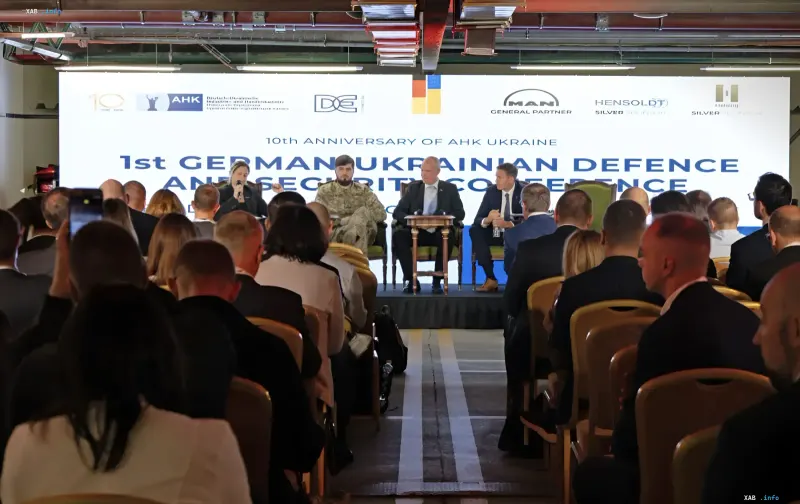
The First German-Ukrainian Defense and Security Conference, organized by the German-Ukrainian Chamber of Commerce and Industry (AHK Ukraine) on the occasion of its 10th anniversary, took place in Kyiv. During a panel discussion, Ukrainian Deputy Minister of Defense Hanna Gvozdyar stated that the ministry is working on expanding cooperation with German defense companies, developing joint production, and attracting funding for the Ukrainian defense-industrial complex. According to her, while the parties discussed only interaction opportunities a few years ago, concrete joint production projects are already being implemented today and need to be scaled up. Representatives of government structures, the defense industry, and chambers of commerce and industry from both countries attended the event.
From Dialogue to Joint Production
A key focus at the conference was the transition from a declarative level to an industrial one. Gvozdyar emphasized that Ukraine is ready to share technologies and combat experience gained during hostilities with European partners. Kyiv estimates that this practical experience becomes a competitive advantage when bringing joint products to market. The German side confirmed its interest in return: AHK Head Rainer Perau previously noted that the German armed forces are modernizing and closely monitoring developments on the Ukrainian battlefield, which stimulates demand for battle-tested solutions.
What Is Needed for Scaling: Contracts, Financing, and Risk Insurance
According to the Deputy Minister, several conditions are required to transition existing projects to mass production mode. First and foremost are long-term contracts, which provide enterprises with predictability and confidence in volumes. Second is direct financing for joint ventures. Third is war risk insurance, which removes the barrier for private investors operating in a conflict environment. Fourth is faster technological cooperation procedures, avoiding wasted time on bureaucratic approvals. Kyiv estimates that the combination of these mechanisms should turn targeted initiatives into sustainable industrial cooperation.
Two New Instruments: Digital Marketplace and Preferential Lending
Two practical instruments to support the defense sector were presented at the conference. The first is the DOT-Chain Defence digital marketplace, which allows military units to independently select necessary equipment, shortening the approval chain between customer and manufacturer. The second is a preferential lending program aimed at enabling defense-industrial complex enterprises to raise funds for expanding and modernizing production facilities. Both mechanisms are designed to accelerate the cycle from a unit's requirement to a delivered product and provide the industry with an accessible source of capital.
Context: 10 Years of AHK Ukraine and Berlin's Position
The conference was part of the celebration of the 10th anniversary of AHK Ukraine, a structure that has served as a bridge between German and Ukrainian businesses, including the defense segment, over the past decade. The choice of defense and security as the theme for the anniversary event reflects a shift in the chamber's agenda: while its work previously focused on civil business, defense cooperation has now become one of its top priorities. The visual presentation of the event—logos of German industrial and defense companies on stage—underlines that major industry players, not just chambers of commerce, are involved in the dialogue.
Broader Trend: Germany Funds Ukraine's Defense Without Washington
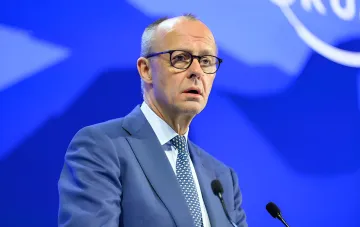
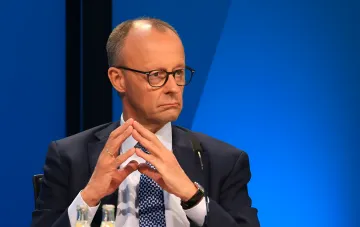
The event fits into the broader context of European support. Ahead of the conference, German Chancellor Friedrich Merz stated that Germany, together with other European and non-American allies, is funding the defense and procurement of equipment for Ukraine without Washington's help. At the same time, the Ukrainian side is actively seeking German partners to develop new types of weapons—specifically, the head of NAUDI announced the search for partners in Germany to create new weapons samples. Taken together, these signals indicate that Kyiv and Berlin's defense-industrial cooperation is shifting from one-off supplies to a systemic partnership with its own production and financial framework.