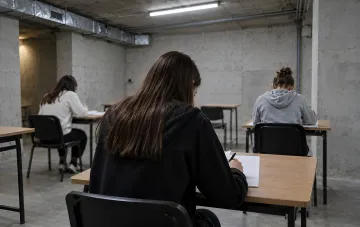
A new stage of the high school reform has begun in Ukraine. From September 1, 2026, 150 academic lyceums across the country have moved to piloting a new educational model for grades 10–12, while the full nationwide launch of the reform is scheduled for September 1, 2027. Accordingly, the 2026/2027 school year will serve as a trial run: it is in these institutions that new curricula, specializations, elective courses, and mechanisms for building individual educational trajectories for students will be tested.
Specialized Model: Three Clusters and an Individual Path
The key change is that high school is becoming specialized. Students will be able to choose a field of study and subjects for in-depth learning in line with their interests and future career plans. A lyceum is required to offer at least three specializations belonging to three clusters: the natural-mathematical (STEM), the linguistic-literary, and the social-humanities cluster. Grade 10 includes an adaptation period during which a student may change their chosen field. After completing grade 9, graduates have two main paths: continue their education at an academic lyceum or enroll in a college.
Modern Learning Spaces: 1.9 Billion Hryvnias for STEM Laboratories
The changes affect not only curricula but also the educational environment. Under the Modern Learning Spaces project, modern STEM spaces and laboratories are being created in 250 educational institutions across 22 regions, with 1.9 billion hryvnias of state subvention allocated for their setup. These are laboratories and classrooms for natural sciences where students will be able not only to study theory but also to conduct experiments, work on projects, and develop practical skills. The space itself is planned to be more flexible: with mobile furniture, separate laboratory zones, and interactive surfaces.
Textbooks and Synchronization of the Transition
The educational base will be updated in stages, in sync with the transition to the new model: textbooks for grade 10 are to appear in 2027, for grade 11 in 2028, and for grade 12 in 2029. Based on the piloting results, the Ministry of Education and Science plans to adjust the necessary decisions and prepare the system for the nationwide launch. The reform's context is reinforced by NMT-2026 data: according to the publication, nearly 40,000 participants failed to reach the minimum score in mathematics, which is attributed not only to the difficulty of the test but also to gaps in foundational knowledge—an argument in favor of a more practice-oriented approach to teaching.
Contradictory Data
The Ministry of Education's official plan calls for a large-scale launch and a pilot in 150 lyceums, but experts point to implementation risks at the local level. According to specialized publications, more than 200 hromadas (local communities) may fail to open academic lyceums due to a shortage of staff, infrastructure, and funding. Thus, one side emphasizes the system's readiness and the allocated subvention, while the other warns that the reform's geographic scope may fall short of what was announced, and some territories will be left without a specialized high school within the planned timeframe.