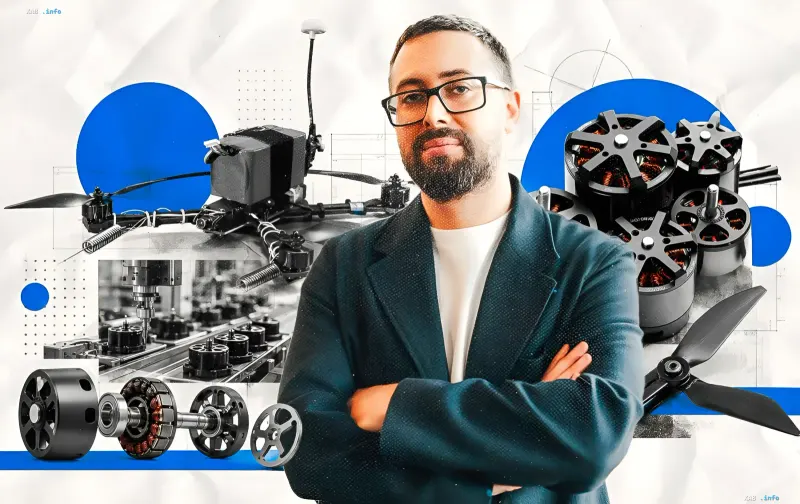
Amidst a protracted conflict and the need for high-tech weaponry, Ukraine is demonstrating its ability to adapt quickly and undergo deep industrialization. A prime example of this process is the creation of Motor-G, a company that, since March 2025, has specialized in the development and production of electric motors for unmanned aerial vehicles (UAVs). The company's founder and CEO, Alexey Greben, told RBC-Ukraine about the journey from idea to creating an ecosystem capable of supplying the Ukrainian Armed Forces with critical components.
From Ventilation to Defense: The Birth of Motor-G
The story of Motor-G began in 2023, when Alexey Greben, who was running a civilian business in the field of ventilation and air conditioning, realized the need to change the direction of his activities. With the start of the full-scale invasion, the desire to be useful to the country pushed aside commercial interests. The idea to produce motors for drones arose logically, given the widespread use of UAVs on the front lines. The company was officially registered in March 2025, but work on the project had been underway for two years prior to that.
From the very beginning, the company's strategy was built on the principle of maximum production localization. However, the path to independence proved difficult. At the start, most components were purchased in China, but Motor-G engineers immediately began looking for ways to replace imports with domestic analogues. In particular, copper wire was never purchased abroad — the company used exclusively Ukrainian raw materials, which became the first step towards production sovereignty.
Technological Paradox: Where are the Boundaries of Localization?
Today, Motor-G claims a localization rate of about 85% of motor components. This means that the housing, stator, copper wire, and silicone cables are produced in Ukraine. Nevertheless, there are bottlenecks that cannot yet be fully closed within the country. The key "bottleneck" remains rare-earth magnets. Despite the company testing batches of magnets from "non-Chinese" raw materials, the main volume is still imported from China.
According to Greben, alternative sources of magnets exist in Europe, but they are either significantly more expensive or unable to ensure the necessary supply volumes. This creates a complex dilemma: on one hand, there is an internal conviction of the need to move away from Chinese components for security reasons; on the other — customers often require cheap and fast solutions, not always paying attention to the origin of individual parts.
The Battle for Efficiency Percentages
For Motor-G, quality and efficiency are the top priorities. Engineers fight for every percentage of efficiency, understanding that the combat effectiveness of a drone depends on it. A more efficient motor allows the device to fly further, carry a larger payload, or develop higher speed with the same energy consumption. To achieve these goals, the team conducts its own electromechanical calculations, develops a unique design, and carefully selects materials, including the thickness and strength of magnets.
Interestingly, the issue of motor noise, which often concerns the military, is considered secondary by the company. Greben asserts that the main source of noise (about 90%) is not the motor itself, but the propeller moving the air. Thus, the fight for silence should be waged not in the field of electronics, but in the aerodynamics of the propellers.
Brain Drain and Development Complexity
Creating an electric motor from scratch is, according to Greben, a more complex task than developing the drone itself or even a mobile phone. The main problem the company faced is a shortage of qualified personnel. The Ukrainian market has only a handful of specialists capable of designing the electromechanical characteristics of a motor and optimizing it. Assembling the R&D team took a lot of time and required a painstaking search for talents willing to work in a highly specialized field.