
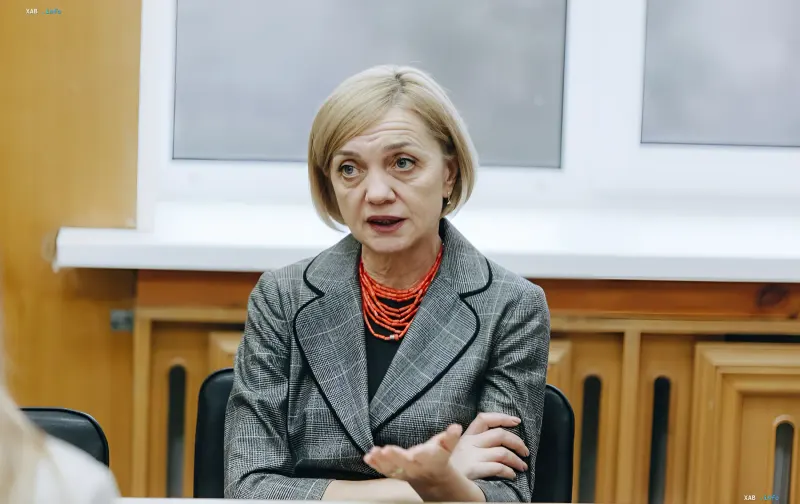
Amendments to legislation are being developed in Ukraine which, according to the authors' intentions, should strengthen the protection of the state language and effectively allow a ban on all Russian-language cultural products in the country. This was stated by Ukraine's State Language Protection Commissioner Olena Ivanovska, a professor and doctor of philology, within the hromadske.talk project. According to her, the corresponding draft law has already been registered in the Verkhovna Rada and has received the support of the relevant parliamentary committee.
Current Legal Framework: What Is Permitted Today
Ivanovska recalled that Article 15 of the current Law "On Culture" restricts the performance of Russian-language songs and other cultural products in Ukraine exclusively to citizens of the Russian Federation. Thus, in the current wording of the law, the formal ban applies not to all Russian-language content, but only to its performance by representatives of the Russian Federation. According to the language ombudsman, this creates a loophole that allows Russian-language musical works and other cultural products to continue being played and demonstrated in Ukraine's public space.
Draft Law No. 15412: What the Document Proposes
On July 15, 2026, draft law No. 15412 was registered in the Verkhovna Rada, aimed at amending legislation on ensuring the functioning of the Ukrainian language as the state language. Specifically, the document proposes revising the provisions of the Law "On Culture". As Ivanovska explained, it is the adoption of this draft by MPs that will pave the way for Russian-language cultural products as a whole to become outlawed in Ukraine. Fragments of the bill's profile card have been published on the official parliamentary documents portal (itd.rada.gov.ua).
Language Ombudsman's Position: From Music to Public Speeches
Olena Ivanovska explicitly stated that she supports tightening relevant restrictions. "I hope there will be changes in the Law 'On Culture' as well (specifically to Article 15), where the Russian-language cultural product will end up outside the law," she said. The ombudsman specifically noted that this includes "those Russian-language musical works that, unfortunately, are still listened to by citizens of Ukraine in some places, even in the public space," and that these works are "moreover, performed." Thus, the initiative affects not only the formal status of performers, but also the very fact of the public sounding of Russian-language music.
Parliamentary Process: Committee Support
Ivanovska emphasized that the Verkhovna Rada Committee on Humanitarian and Information Policy, chaired by Mykyta Poturaiev, supported this legislative initiative. "And this made it possible to submit all these recommendations, all these amendments to the Verkhovna Rada," the expert stated. Thus, the document has passed the stage of intra-parliamentary expertise and is now under review by the full plenary assembly. The adoption of the law in the proposed wording will require going through standard procedures: first and second readings and signing by the president.
Context: Language Policy and Public Discussion
The initiative to tighten language legislation fits into a broader context of efforts to establish Ukrainian as the sole state language. Previously, the Ukrainian media space discussed issues regarding how many Ukrainian citizens actually speak the state language and what factors hinder a full transition. The topic of the need to switch to the Ukrainian language for service and entertainment professions—tarot readers, coaches, beauty bloggers—in the digital environment was also raised separately. Proposals to increase fines for violating the current language law were also discussed. Draft law No. 15412, if adopted, will become the next stage in this sequence—from administrative sanctions to a direct ban on an entire class of cultural products.


