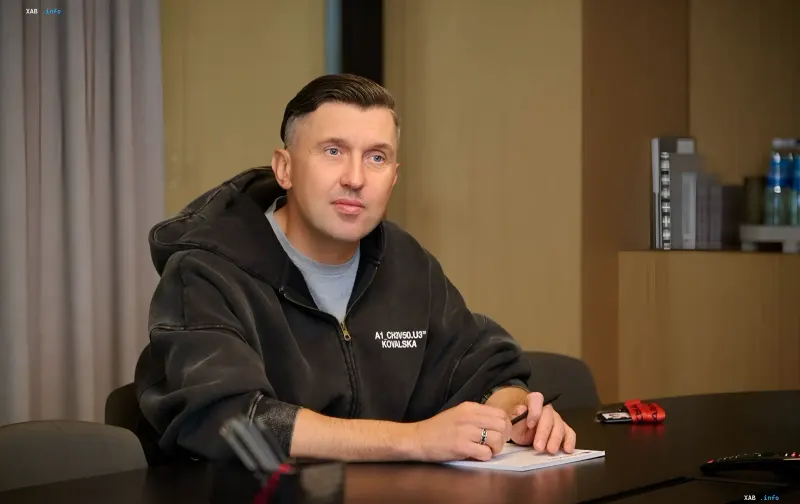
The Ukrainian real estate market has entered a phase that industry participants call "standby mode": according to data cited in the RBC-Ukraine report, the market has declined by 20–25% over the past year, with buyers increasingly postponing deals amid the war and general uncertainty. Against this backdrop, developers observe that quality, autonomy, and safety features are becoming more important than price and square footage. In an interview with RBC-Ukraine, Serhiy Pylypenko, CEO of the Kovalska company, spoke about what a modern residential complex should look like, when demand might recover, and what should be demanded of buildings in terms of safety.
Market in Standby
According to Pylypenko, the current pause in transactions is a consequence not so much of price factors but of uncertainty: people are not ready to make long-term financial decisions under wartime conditions. This is why, as the executive notes, the importance of quality, autonomy, and safety parameters—not just square meters—is growing. The consumer, in his assessment, has become more demanding and rational: they are not looking at the entry price, but at how the property will perform several years after purchase.
From Mass Product to Quality
The company summarized its performance: since starting construction in 2002, Kovalska has commissioned one million square meters of real estate. Pylypenko recalls that the market has gone through several boom-and-bust cycles over these years. "Everything built in the early 2000s was bought up in advance, and no one thought about comfort. Real estate was a mass product without specific quality requirements," he says, clarifying that he is referring to the market's average standard, not his own product. After the market cooled during the 2008–2009 financial crisis, developers began seeking ways to differentiate, and a new cohort of players formed: before the crisis, key developers included Kyivmiskbud and a few others. After several cycles of fluctuations, Kovalska, according to Pylypenko, found its niche—primarily in quality housing and commercial real estate.
Vertical Integration as a Competitive Advantage
The executive cites long-term facility reliability throughout the life cycle as a key competitive advantage. "We invest much more per square meter in our buildings than the average market standard," Pylypenko claims. According to him, Kovalska is not just a developer but also the largest domestic producer of building materials: the company extracts raw materials itself, produces concrete, wall materials, and insulation systems, and designs engineering solutions. As he explains, this provides a competitive edge: the houses are warmer, have better sound insulation, and their residents save on heating and electricity. As a result, the company’s housing is 15–20% more expensive than the average market offering depending on the segment, but, according to Pylypenko, the company is selling not just square meters, but real estate that retains and increases in value 5–7 years after purchase.
Investment Logic: Real Estate That Appreciates
Purchasing housing, the interviewee emphasizes, is not only a consumer decision but also an investment one. Pylypenko cites a characteristic example: an apartment purchased at the investment stage for $50,000 might be worth only $35,000 three years after the building is commissioned due to poor material quality and improper building maintenance. "As a result, the person receives neither the expected comfort nor the return on investment," he notes. The company, according to him, operates on a different logic—creating real estate that preserves and multiplies its value over time, while the quality and consumer properties of the buildings build trust and motivate buyers to choose Kovalska again.
Diversification and Risk-Oriented Approach
Answering a question about business resilience, Pylypenko explains that a branched and diversified structure—raw material extraction, construction material production, and sales—makes development projects more financially stable. "When a business is branched and diversified, it gives confidence that despite the difficulties of a specific market, we will still fulfill our obligations," he says. In periods when the market is not experiencing its best phase, the company, according to him, does not change construction tempos, investing part of the profits from manufacturing plants into real estate. The second reliability factor is avoiding the race for quantity: only 3–5 residential complexes are being implemented simultaneously. Pylypenko contrasts this approach with developers who "built 10 or more million square meters," but where are they now: "Where are Kyivmiskbud, Ukrbud, and Arkada? Now those are tens of thousands of abandoned investors." The company's risk-oriented approach is to take on only the amount of projects that can be controlled to the finish line and guaranteed to be handed over to owners, even when sales stall due to external factors. As an illustration, he points to building 13-17 of the Rusanivska Havan residential complex, where more than 90% of apartments were bought out even before commissioning.