
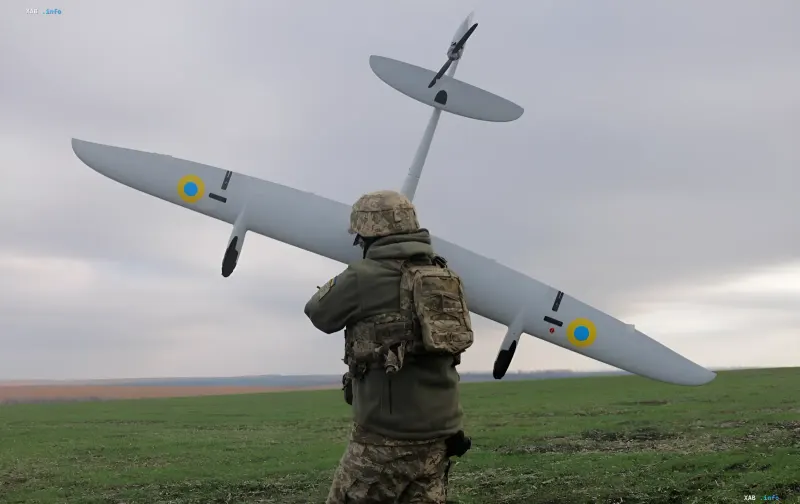
On the night of August 30, 2026, Ukraine's Unmanned Systems Forces (USF), according to Kyiv's statement, delivered a massive strike on two Russian military airfields — "Yeisk" in the Krasnodar Krai and "Millerovo" in the Rostov Oblast. As reported by RBC-Ukraine, citing the Telegram channel of USF commander Robert Brovdi ("Madyar") and the drone developers at Fire Point, the operation destroyed five air defense assets, ammunition depots, and technical facilities. In a frame published by the Fire Point channel, a Ukrainian soldier in camouflage is seen holding a reconnaissance-strike UAV bearing Ukrainian identification marks — a blue circle within a yellow ring.
Strike on Yeisk: FP-1 drones and fires at the airfield
According to the USF, units of the 1st Separate USF Center used FP-1 drones to deliver precision strikes on the military airfield in Yeisk and nearby settlements in the Krasnodar Krai. Satellite imagery from NASA and geolocation data, cited by Ukrainian sources, record large-scale fires in at least three locations following explosions at the site. It was at this location, Kyiv claims, that air defense elements and ammunition storage facilities were hit.
Main target in Millerovo — the DRL-27 dispatch radar
In the Rostov Oblast, drone strikes hit facilities at the "Millerovo" airfield and near the settlement of Dolotinko. The key target of the operation is named as the DRL-27 module — an airfield dispatch radar that, according to Ukrainian sources, is a critically important element of air traffic control and operates as part of a unified system with the PRL-27 landing locator. Destroying such a radar, in Kyiv's logic, hampers the use of the airfield for the takeoff and landing of military aircraft. All reported losses of equipment and infrastructure, according to the message, have been confirmed by follow-on reconnaissance data.
Part of a systematic "hunt" for critical targets
According to Ukrainian commanders, the strikes on Yeisk and Millerovo were part of a broader nighttime operation: on the same night, the defense forces reportedly hit three important military-industrial facilities — an oil refinery, a drone storage base, and a military airfield. In addition, during August 29 and on the night into August 30, Ukrainian units, per Kyiv's statement, struck ammunition depots, command posts, and radar stations in what the USF describes as a "systematic hunt for critical targets."
Contradictory data
The provided materials contain a discrepancy in the chronology. The introductory part of the message dates the main strike on Yeisk and Millerovo to "the night of August 30," while the summarizing paragraph describes the same series of actions as "on the night into August 30" (i.e., the night from the 29th to the 30th), with some strikes on depots and radar stations described as occurring "during August 29 and on the night into August 30." Thus, the exact night on which the airfields were struck (August 29–30 or 30–31) is not consistent in the text. Moreover, all data on the destruction of five air defense assets, depots, and the DRL-27 radar come exclusively from the Ukrainian side and the Fire Point developers; independent confirmation of each specific target by neutral observers or Russian authorities is absent from the materials, although satellite imagery from NASA is provided for some of the damage.
Significance of the operation
If the reported losses are confirmed, the strikes represent an attempt to simultaneously weaken air defense and deprive Russian airfields in the rear of the ability to properly service aviation by destroying dispatch radars. The use of relatively inexpensive Fire Point drones to hit costly air defense elements and airfield infrastructure continues the line the USF have pursued throughout the campaign. A final assessment of the scale of the damage is possible only after independent analysis of satellite data and additional intelligence sources.