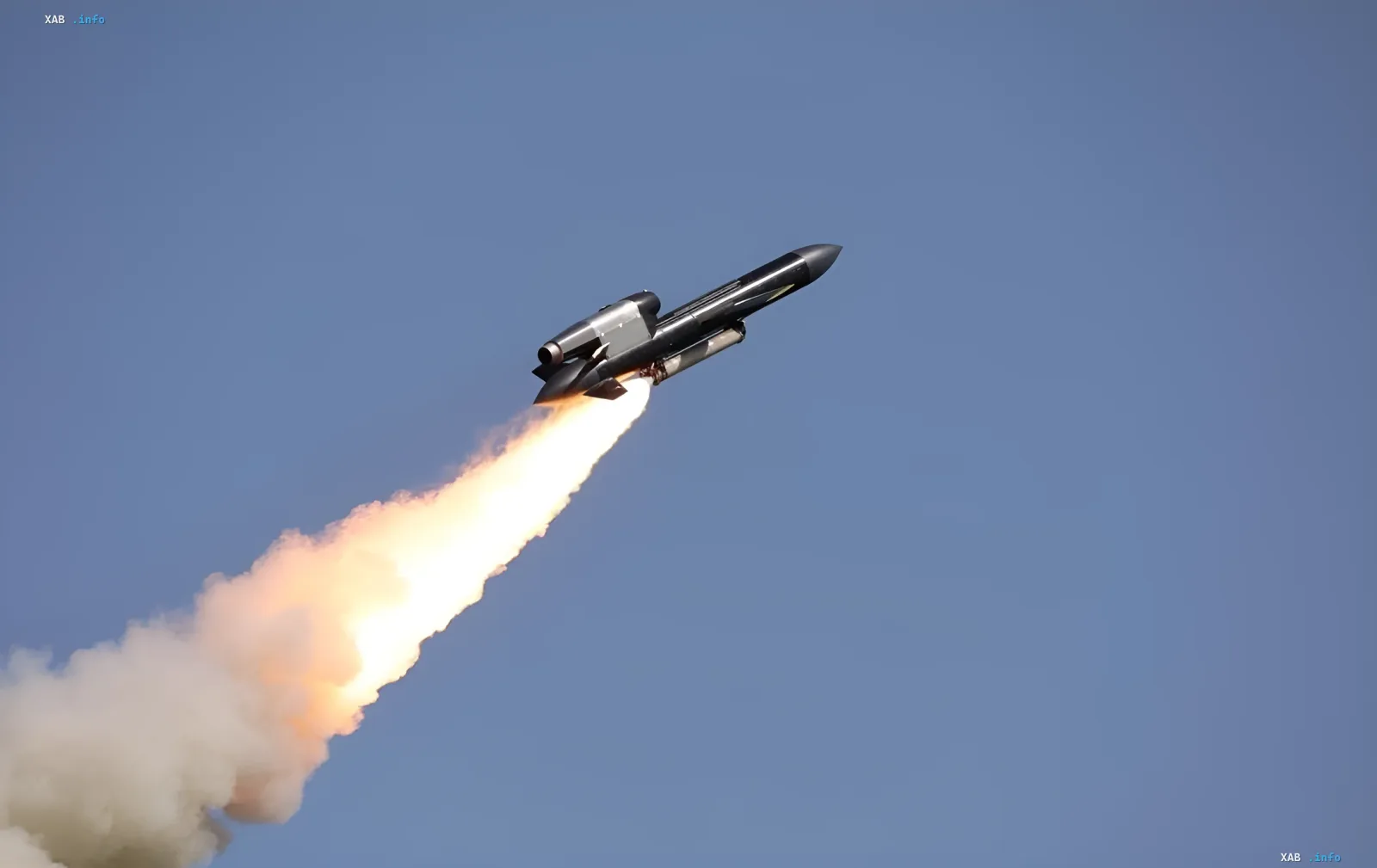
On the night of June 10, explosions rocked the skies over Cheboksary. The target of the strike was a strategically important defense plant producing components for Russian drones and missiles. According to Ukrainian President Volodymyr Zelenskyy, the attack was carried out by FP-5 'Flamingo' cruise missiles. This event marked just the latest chapter in the history of this weapon, which over the past year has demonstrated its ability to strike targets deep within the enemy's rear.
From concept to mass production
The FP-5 'Flamingo' missile is the result of a collaboration between the Ukrainian company Fire Point and the British firm Milanion Group. The first information about the development of long-range domestic weaponry emerged in 2025. In August of that year, photos of the finished missiles were published, and Ukrainian Defense Minister Denys Shmyhal officially confirmed the existence of a 'very powerful' means of destruction.
Experts from Defense Express identified the 'Flamingo' as the Ukrainian version of the FP-5 missile, developed by a British design bureau headquartered in the UAE. The prototype model was first presented at the IDEX-2025 international exhibition in February 2025.
Mass production began in mid-2025. Initially, the rate was about 30 missiles per month, but plans called for a significant increase in output to 210 units monthly. The path to mass production was not smooth: in February 2026, Volodymyr Zelenskyy reported a disruption in factory operations following a Russian missile strike that destroyed part of the production line. Nevertheless, production was restored.
Characteristics and tactics of use
The main feature of the 'Flamingo' is its ability to cover huge distances. The missiles have demonstrated the ability to fly more than a thousand kilometers, striking objects deep in the rear. According to Fire Point co-founder Denys Stilerman, the missile's design significantly complicates the work of Russian air defense systems.
"The missile flies at a sharp angle, not diving from above, so it is harder for Russian air defense to detect and react quickly," explains Stilerman. However, such a flight profile requires perfect intelligence preparation: designers need to know the exact height of every building in the target area. Additionally, the missile's composite body significantly reduces its radar visibility.
Chronology of strikes: from Crimea to the Volga region
The history of the combat use of 'Flamingo' includes several significant episodes demonstrating the expansion of the geography of attacks:
- August 30, 2025: The first known attack on an FSB outpost in Crimea. According to media reports, three missiles hit the facility, damaging six hovercraft.
- September 23, 2025: A strike on an instrument factory in Belgorod producing equipment for aircraft manufacturing. The attack caused a fire in one of the workshops.
- November 13, 2025: Use of the missile against targets in the city of Orel.
- January 2026: Attack on the Kapustin Yar missile range in the Astrakhan region. Hangars and infrastructure for the preparation of ballistic missiles were hit, including the 'Oreshnik' complex.
- February 12, 2026: Strike on the GRAU arsenal of the Ministry of Defense of the Russian Federation in the settlement of Kotluban (Volgograd region). The facility is considered one of the largest ammunition storage sites of the Russian army.
- February 20, 2026: Strike on the Uvatkinsk Machine Building Plant (Udmurtia). The enterprise, located 1400 km from the border, produces 'Iskander', 'Oreshnik', and 'Topol-M' ballistic missiles.
- May 5, 2026: Attack on the 'VNIIR-Progress' plant in Cheboksary. The enterprise produces navigation receivers for Shahed drones and 'Kalibr' missiles.
Effectiveness and Air Defense response
There is no open data on the exact number of 'Flamingo' missiles shot down and the types of air defense systems used. However, statistics show that intercepting all missiles is not always possible. For example, during the first attack on Cheboksary, out of six launched missiles, only one reached the target, according to preliminary data.
At the same time, Russian media reported the shooting down of four 'Flamingo' missiles over Russian territory during recent attacks. Nevertheless, the fact remains a fact: on the night of June 10, explosions rocked Cheboksary, and columns of smoke rose above one of the production facilities, confirming the success of the strike on the critical infrastructure of the defense complex.


