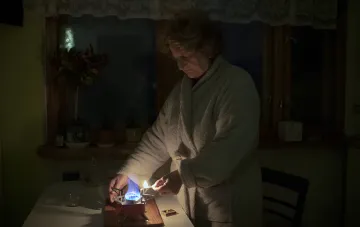
Russian troops launched a new strike on Ukraine's energy infrastructure, damaging Ukrenergo substations in particular. As of the evening of November 20, emergency power outages were introduced in a number of regions due to the consequences of the shelling, and Ukrainian nuclear power plants were forced to reduce their capacity. This was reported by the national energy company.
Emergency outages in Poltava and Kharkiv regions
"As of this hour, emergency power outages are in effect in the Poltava and Kharkiv regions. These restrictions are necessary to stabilize the power system. A return to hourly outage schedules will occur as soon as the situation allows," Ukrenergo said in a statement. The company emphasizes that the emergency mode is introduced to prevent cascading failures in the grid and maintain its stability.
Scale of blackout: Kyiv and ten regions
As a result of the strike, large-scale blackouts were recorded in Odesa and surrounding areas. In addition, consumers in Kyiv, as well as in Vinnytsia, Dnipropetrovsk, Donetsk, Zaporizhzhia, Kirovohrad, Odesa, Kharkiv, Kherson, Cherkasy, and Chernihiv regions, were left without electricity. According to municipal services, the Pecherskyi, Solomianskyi, Holosiivskyi, and other districts of the capital were partially de-energized. It is noted that outages were recorded even in western Ukraine, where regular schedules ranging from 0.5 to three stages were planned to be in effect during the day.
Repair crews work around the clock
"Power engineers are already working at damaged facilities wherever it is safe. However, restoration is currently impossible at some facilities due to the threat of new strikes," Ukrenergo said. The company points out that the work is complicated by repeated attacks on energy facilities that had already been restored after previous shelling, which forces some complex repairs to be started over. At the same time, repair crews and involved services, according to the energy workers, are working around the clock and in a coordinated manner to restore electricity to consumers as quickly as possible.
Consequences for transport and nuclear generation
In Odesa, the movement of electric transport temporarily stopped due to the power outage: neither trams nor trolleybuses are running. Simultaneously, Ukrainian nuclear power plants were forced to reduce their capacity on November 20 amid a large-scale attack, which further reduces the volume of generation in the system during hours of peak demand.