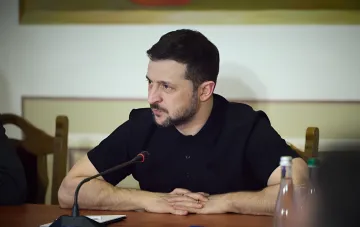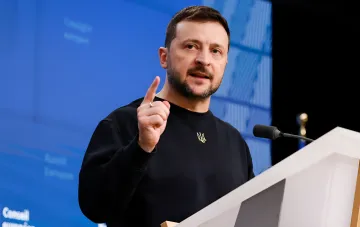
On November 13, at a meeting with journalists, President of Ukraine Volodymyr Zelenskyy stated that the United States had for the first time directly asked Kyiv whether Ukraine would agree to withdraw from the unoccupied part of the Donetsk region in exchange for NATO membership. "The Americans asked the question: 'If Ukraine is in NATO, will it leave the Donbas?' This was the first time," AFP reported, citing Zelenskyy. According to the president, no specific written proposal currently exists. He emphasized that if the initiative were confirmed by the US side and other alliance partners, the issue would be submitted for public discussion, as he cannot make such a decision "on his own." At the same time, Zelenskyy added that any agreements must be "unconditionally without any recognition of the occupied territories as Russian" and that "Ukraine does not retreat and does not give its lands to terrorists."
Security guarantees without neutrality
During the same statement, Zelenskyy reported that Kyiv does not intend to enshrine a neutral status in its constitution, as this would not provide long-term security guarantees. According to him, the US is currently discussing guarantees similar to Articles 4 and 5 of the North Atlantic Treaty, but without the deployment of American troops on Ukrainian territory. Washington, the president noted, characterizes these arrangements as bilateral and draws parallels with formats the United States has with Israel and a number of Middle Eastern countries.
Experts: more speculation than a diplomatic proposal
Ukrainian analysts interviewed by Deutsche Welle reacted skeptically to the idea. Serhiy Solodkyy, director of the New Europe Center, stated that the proposal "raises more questions than answers" and that its feasibility depends on those answers. In his opinion, it is first necessary to understand at what level the idea was proposed and how many NATO countries support it. "Objectively, this looks more like information leaked to analyze the reaction," Solodkyy noted. He recalled that similar ideas were discussed before Donald Trump came to power and did not receive much enthusiasm from alliance members. "In Ukraine, they were not enthusiastic about it either, noting that Ukraine must be a NATO member within its internationally recognized borders, not in some truncated version," the expert added.
"Empty guarantee" and a second Budapest Memorandum
The main objection raised by experts is that the US cannot unilaterally fulfill a promise of Ukraine's accession to NATO. Oleksandr Kraiev, director of the North America program at the Foreign Policy Council "Ukrainian Prism," pointed out that at least half of the alliance's members still doubt the expediency of admitting Ukraine. "How do the Americans imagine they will force all nearly 30 countries to accept Ukraine at once? It is simply impossible. In essence, this is an empty guarantee," he stated. Kraiev also warned that Russia understands perfectly well the impossibility of such a scenario and that if the US makes such a promise, "Russia's hands will be untied," and Ukraine will receive a "second Budapest Memorandum, just with a different name."
A blow to Western unity and a dangerous precedent
Oleksandr Khara, an expert at the Center for Defense Strategies and a diplomat, assessed the proposal as a "mine that the Kremlin, through the hands of the Americans, is planting under transatlantic unity and NATO as such." According to him, the US, as a key country in the alliance, "will definitely not be able to ensure voting, and in some countries, referendums on Ukraine's NATO membership." Khara also drew attention to the fact that all such proposals bypass the issue of responsibility for aggression, war crimes, and acts of genocide: "One of the reasons for this war is that Russia was not punished for previous crimes." Experts were also extremely critical of a possible referendum in Ukraine on exchanging NATO membership for the unoccupied territories of the Donetsk region. Khara stated that giving up territory violates not only Ukraine's constitution and national interests but also destroys the global order in which borders cannot be redrawn by force of arms: "And it makes no difference whether the citizens of Ukraine vote for such a proposal or against it. This is a very dangerous precedent."