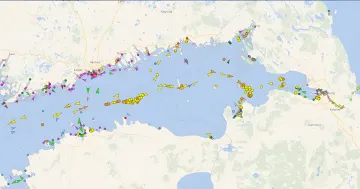
On Saturday, September 6, 2026, the United States Central Command (CENTCOM) reported strikes on three oil tankers belonging to the Islamic Revolutionary Guard Corps (IRGC) in response to the launch of ballistic missiles at two U.S. military vessels. According to the command, the strikes were carried out off the coast of Harg Island and near Yask, as well as outside the Persian Gulf, where the unladen tanker M/T Kylo was "completely destroyed" after multiple hits. CENTCOM emphasized that the U.S. aircraft carrier and guided-missile destroyer "successfully evaded numerous unprovoked attacks by Iran," with neither vessel sustaining any damage.
Course of the Exchange of Strikes and Timeline of Events
As noted by U.S. media, earlier in the current week the two sides exchanged military strikes for the first time in over a month, making Saturday, September 6, the day of the sharpest escalation. According to CENTCOM, the IRGC was the first to fire ballistic missiles at the U.S. aircraft carrier and destroyer, after which U.S. forces moved to retaliatory action against Iranian maritime assets. Admiral Brad Cooper, commander of Central Command, articulated Washington's position in firm terms: "Let the message to the IRGC be clear: if you fire on two of our ships, we will inflict even greater economic damage — we will destroy three of yours." Thus, the strikes on the tankers were presented not as an end in themselves, but as a proportional yet intensified response to the missile attack.
The "Shadow Network" and the Economic Dimension of the Conflict
The CENTCOM statement underscores that the destroyed vessels "are part of a multi-billion-dollar shadow network that funds the IRGC and its regional proxies." This formulation shifts the conflict from a purely naval plane to an economic one: Washington is effectively declaring war on the logistical infrastructure through which, according to its data, Iran finances proxy groups in the Middle East. The destruction of M/T Downy, M/T Stark 1, and M/T Kylo may signal U.S. readiness to move to the systematic dismantling of Iran's oil exports, which in the longer term could hit the budgets of Tehran and its allies.
Pentagon Reaction: Hegseth Threatened to "Sink Everything"
Later that same day, the head of the Pentagon, Pete Hegseth, expanded the geography of potential strikes, stating that the United States is capable of attacking Iran's fleet of oil tankers both in the Middle East and in the Indo-Pacific region. "It's simple: if Iran starts firing on U.S. ships, we will destroy and sink their oil tankers. All they have to do is stop shooting at the U.S. military," Hegseth said. He also added that the Iranian tanker fleet is "defenseless" because Tehran has "neither a navy nor an air force" capable of protecting it. These statements effectively establish a new escalation ladder: any further IRGC attack on U.S. vessels could trigger a massive campaign against Iranian ships in the open ocean.
Contradictory Data
Meanwhile, Russian press has noted discrepancies in the description of the same episode. For instance, the outlet "Moskovsky Komsomolets" (mk.ru) in a headline dated September 5 reports that "Iran attacked U.S.-linked tankers in the Strait of Hormuz," shifting the focus from U.S. military vessels to civilian or semi-military ships linked to Washington. At the same time, CENTCOM, the Pentagon, and the Ukrainian outlet RBC.UA consistently speak of a missile barrage directed specifically at a U.S. aircraft carrier and destroyer, not tankers. It is possible that this refers to two related but distinct incidents in the Strait of Hormuz, or to a difference in the classification of the targeted objects. Pending additional confirmation from Tehran, both versions remain in the realm of public debate.
Context and Risks of Further Escalation
The current exchange of strikes is taking place against the backdrop of months of rising tension in the Persian Gulf and around the Strait of Hormuz — the artery through which a significant share of the world's oil exports passes. The shift from isolated incidents to the deliberate destruction of the tanker fleet could trigger a chain reaction: Iran, in turn, is capable of intensifying the actions of proxy forces in Yemen, Iraq, and Lebanon, as well as employing asymmetric means — naval mines, drones, cyberattacks on port infrastructure. Hegseth's statement about the possibility of strikes in the Indo-Pacific region introduces a new geographic vector into the conflict, raising the risk of drawing additional players into the confrontation and making the situation extremely unpredictable for the coming weeks.