The top military leadership of the United States has sent Defense Secretary Pete Hegseth an unprecedented warning in tone: the military operation against Iran, ongoing since February 2026, is undermining the combat readiness of the U.S. armed forces and must be halted. This is reported by The Washington Post, citing a classified document, the “Secretary of Defense's Book of Orders” (SDOB), dated August 14, 2026. According to the outlet, the document, which assesses the availability of Pentagon forces and resources worldwide, sees the heads of the Army, Navy, and Air Force, along with four-star commanders of the unified combatant commands, explicitly expressing disagreement with any further expansion of the presence in the Middle East.
“Disagreement” from Three Commands
The commanders of U.S. European Command, U.S. Pacific Command, and U.S. Southern Command recorded a formal “disagreement” in their sections of the SDOB with the order to redeploy additional ships, aircraft, and intelligence systems to the Middle East theater. As an anonymous source familiar with the document's contents explained to The Washington Post, “the operation in Iran, already six months in, has become too complex and has dragged on.” According to the same source, transferring key assets from regional reserves not only depletes the commands' own stockpiles but also deprives them of the ability to carry out basic tasks of defending U.S. territory and protecting allies.
Critical Shortfall in the Navy and the Strait of Hormuz
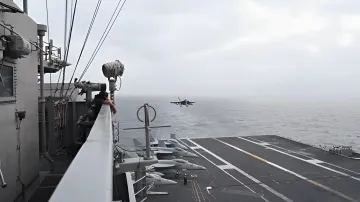
The most acute situation, according to the report, has developed in the Navy. It is the fleet that is carrying out the blockade of Iranian ports and the patrol of trade routes in the Strait of Hormuz — the artery through which about a fifth of the world's oil exports pass. The depletion of arsenals and the continuous rotation of ships have led to the U.S. Navy operating at the limit of its capabilities, with recovery time between operations reduced to a minimum. This, in turn, creates risks to the safety of shipping in the Persian Gulf and increases the likelihood of incidents with Iranian forces.
Vulnerability in the Pacific and the China Factor
The transfer of carrier strike groups, submarines, and reconnaissance aircraft from the Pacific region to the Middle East has already raised concerns among U.S. allies in the Asia-Pacific. According to The Washington Post, several alliance partners have warned Washington that the reduction of the American military presence in the western Pacific leaves them vulnerable to possible actions by the PRC. Thus, the Pentagon's attempt to simultaneously conduct a protracted operation in Iran and maintain a strategic balance in the Indo-Pacific region is, by the commanders' assessment, impossible without a critical decline in readiness in both theaters.
The Pentagon Stays Silent
Sean Parnell, a spokesperson for the Secretary of Defense, commenting on The Washington Post's publication, stated that the Pentagon “does not comment on internal operational discussions and risk assessments.” Official Washington neither confirmed nor denied the contents of the August 14 SDOB, did not disclose the list of specific redeployments, and did not clarify what decisions Hegseth made after receiving the report. As of the publication date of the article (August 30, 2026), no public statements from the White House or the Pentagon about a review of the operation's strategy in Iran had been made.