
A significant surge in military activity by the United States has been recorded in the area of the strategically vital Strait of Hormuz. According to monitoring data and official sources, on the night of September 23, US reconnaissance aircraft were spotted in the immediate vicinity of the Iranian islands of Kishm and Hengam. Simultaneously, flights of fighter jets and small unmanned aerial vehicles were observed over the western Iranian province of کرمانشاه (Kermanshah), highlighting the scale of ongoing operations.
Force Redeployment and Regional Tensions
Experts and analysts note that alongside reconnaissance flights, Washington has reportedly redeployed 12 F-16 fighter jets from Spangdahlem Air Base in Germany directly to the Middle East region. These steps are being taken against the backdrop of escalating tensions around the region's key transport arteries. Tensions in the Strait of Hormuz have increased significantly following the outbreak of a potential confrontation between the US, Israel, and Iran in late February 2026, when the Islamic Revolutionary Guard Corps imposed restrictions on shipping.
In response to Tehran's actions, the United States established a naval blockade of Iranian ports. According to official US government data, oil transportation volumes through the strait plummeted from a peak of 21.6 million barrels per day in the final quarter of 2025 to a critical low of 4.9 million barrels per day in the second quarter of this year. Nevertheless, the current situation demonstrates unexpected trends toward a partial recovery in hydrocarbon shipment figures.
Contradictory Data
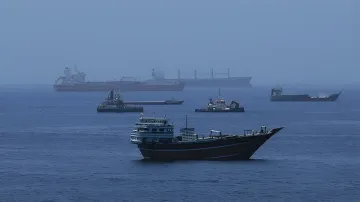
While official reports speak of a strict naval blockade and severe restrictions, vessel tracking services are recording paradoxical dynamics. TankerTrackers reported that the volume of crude oil passing through the US Navy blockade zone doubled in less than a month, reaching approximately 13 million barrels per day (with actual volumes around 10.35 million bpd excluding exports from Fujairah and Mina al-Fahal). Analysts attribute this growth to Saudi Arabia being forced to reroute export flows through the Persian Gulf following damage to its strategic East-West pipeline, alongside exporters finding new logistical pathways.
Expert Assessment and Transport Security
Currently, the passage of ships and tankers through the Strait of Hormuz is carried out under enhanced security measures overseen by the US Central Command. The situation remains extremely fragile: Iran continues to insist on its sovereign right to control the strait, while international players attempt to ensure uninterrupted energy supplies to the global market, navigating between the risks of military clashes and the need to stabilize oil prices.