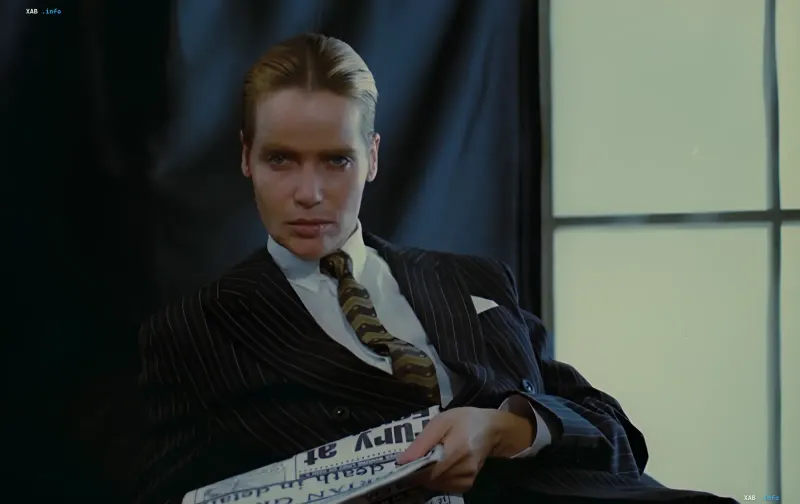
German model, actress, and artist Veruschka, whose real name was Vera Gottliebe Anna Gräfin von Lehndorff, has passed away at the age of 87. According to the German tabloid Bild, the news of her death was confirmed by a close relative: the model passed away at her home in Berlin surrounded by friends and family. Veruschka gained worldwide fame in the 1960s through collaborations with the era's leading photographers, appearances on international magazine covers, and unusual body art art projects.
Childhood in the Shadow of the Anti-Hitler Plot
Veruschka was born on May 14, 1939, in East Prussia to a noble family. At the age of five, she lost her father, Heinrich Count von Lehndorff-Steinort, a member of the German resistance movement who joined the conspiracy to assassinate Adolf Hitler. Following the failure of the plot, he was arrested and executed on September 4, 1944, at Plötzensee Prison in Berlin. Nazi authorities persecuted other family members as well: her pregnant mother was sent to a labor camp, and the young girl along with her sisters was placed in an orphanage. After the end of World War II, the family lost their ancestral estate, and Veruschka faced refugee camps, numerous relocations, and changing schools.
Path to Fame: From Florence to Vogue Covers
Standing 183 cm tall, the model became one of the most photographed figures of her generation. Her career began in Italy, where she moved after studying art: in Florence, photographer Ugo Mulas noticed the young German's striking appearance and suggested she try her hand at modeling. Later, Veruschka worked in Paris and New York, posing for photographers such as Richard Avedon, Irving Penn, and Franco Rubartelli, and gracing the covers of international Vogue editions. In 1967, her photograph graced the cover of the American magazine Life, and by 1970, according to various reports, she had appeared on around 800 magazine covers, ranking among the world's highest-paid models.
'Blow-Up' and Body Art Experiments
She gained particular recognition for her role in Michelangelo Antonioni's film Blow-Up (1966): although the model appeared in only two scenes and spoke a single line, this work made her famous far beyond the fashion industry. Veruschka did not want to limit herself to a traditional modeling career—she experimented with transformations, makeup, and body art, collaborating with artists and photographers, including, according to various sources, Salvador Dalí. In her projects, she used her own body as a canvas, creating the illusion of merging with nature, stones, plants, and architectural objects.
Leaving Fashion and Life in Art
In the mid-1970s (according to Bild, in 1975), Veruschka effectively stepped away from classic modeling following a conflict with the editor-in-chief of American Vogue. Unwilling to be perceived solely as a beautiful woman, she continued to pursue painting, photography, and performance art. At the same time, she periodically returned in front of the camera: in 1975 — wait, in 2006 she played a small role in Casino Royale, the 21st James Bond film, and in 2017 she became the face of a collection by Swedish brand Acne Studios. German Vogue calls Veruschka the first German supermodel.
Final Years in Berlin
Veruschka spent her final years in seclusion, yet continued to interact with young artists. She passed away at her home in Berlin surrounded by loved ones. The cause of death has not been specified, according to available reports.