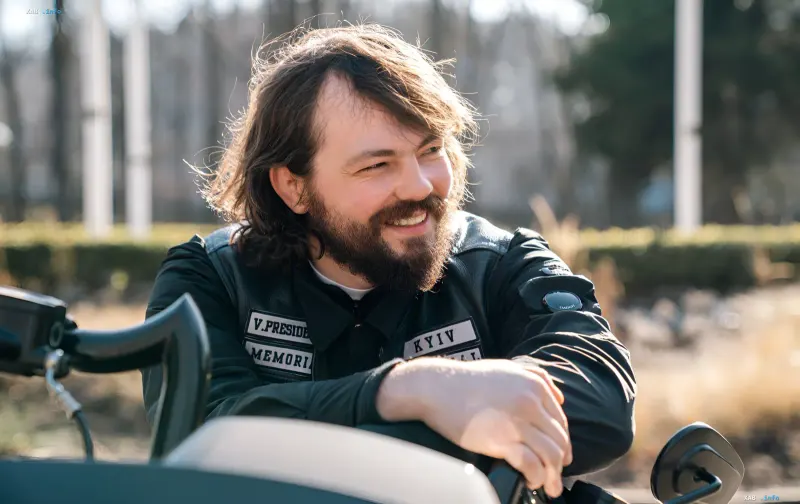
Artem Grot, a Special Operations Forces veteran, founder of the M13 FIGHTS community and the MEMORIA motorcycle club, commented on a statement by the Minister for Veterans' Affairs, Vitaliy Kim, that after the end of the war some military personnel may turn to crime. According to Grot, the raised issue should not be ignored, but at the same time practical ways to solve it must be sought. He said this in an interview with "Novosti.LIVE," which RBC-Ukraine references.
The economic factor as the key cause
Grot pointed out that in the future there is indeed a risk that some veterans will end up in the criminal environment. He named the country's economic situation, and in particular the inadequate level of wages, as one of the main reasons. "Right now we have 2.3 million people in the 'veterans' category in our country, and this number also includes the families of the fallen. This number will grow, and, of course, among them there will be people who will turn to crime. Why? Because the country's economic circumstances will not allow their life needs to be met 100%, and an ordinary job with a salary of up to 1,000 on a 5/2 schedule will not cover them," he explained.
The problem existed before the full-scale invasion
The veteran emphasized that this is not a new phenomenon. According to him, some of the people who went through the ATO (Anti-Terrorist Operation) were already involved in crime before the full-scale invasion and before Vitaliy Kim took up the post of minister. "Not a single veteran I have spoken with, not one, has said — no, a military person will absolutely not be involved in crime, that is impossible, that is a fabrication," Grot noted, emphasizing that the problem is systemic in nature and is not reducible to individual statements.
The risk of forming a negative image of the veteran
At the same time, according to Grot, some of his comrades-in-arms believe that the public airing of the topic by a minister who himself did not serve may contribute to forming in society the perception of veterans as a potential threat. "I was told that this undermines the veteran's position in society, that because of such statements society perceives the veteran as potential criminal element," he relayed the words of his interlocutors. At the same time, Grot stated that he does not want to "defend the minister" or "engage in empty posturing," and called for looking at the essence of the problem and seeking ways to solve it.
Adaptation through veterans' sport
Speaking about the reintegration of military personnel upon their return from the front, Grot emphasized the importance of creating conditions for self-realization. As an example, he cited the activities of his own community, which develops veterans' sport. "We founded fist-fighting (bare-knuckle boxing) in 2025 and have already held six tournaments. We have a rule — only military personnel and veterans take part in the tournaments," he said, adding that among the participants there are veterans with amputations and injuries.
Para jiu-jitsu as a tool for adapting wounded fighters
A separate area of the community's work, Grot named para jiu-jitsu — a type of grappling on which he has placed his bets from the standpoint of adapting people with various injuries. According to him, this sport is well suited for military personnel with amputations, since it requires minimal investment in equipment: only a floor and tatami mats are needed. "Para jiu-jitsu works harmoniously for people with leg amputations, and they can show good results on equal terms with people without injuries," the veteran noted.