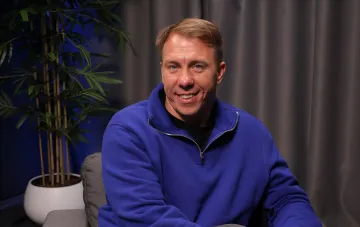

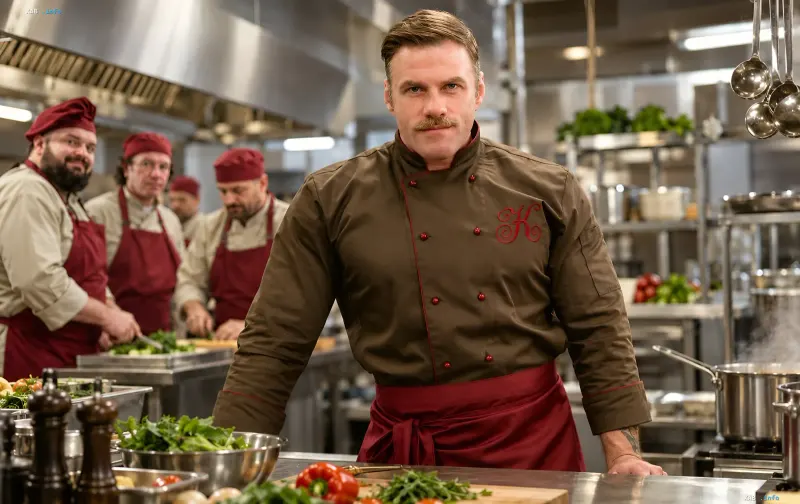
Ukrainian actor and combat veteran Volodymyr Rashchuk, known for the series "Kotliarevskyi", spoke in a blitz interview with Styler (RBC Ukraine) about how his combat experience changes his approach to working in cinema, why he turns down projects due to a director's stance, and what proved to be the hardest part of losing 40 kilograms. In the series, Rashchuk plays Chef Borshchevsky, who recreates forgotten dishes from Kotliarevsky's "Eneida", while the actor himself, according to him, collects family recipes and dreams of opening a restaurant dedicated to the Greeks of the Azov region. The interview was published against the backdrop of discussions on how Ukrainian cinema handles the theme of war and the return of veterans.
"An Actor Answers for Himself, a Producer Answers for Everyone"
Rashchuk launched his own production company and explained in the interview how his mindset changed after moving to the producer's side. As an actor, he reads a script and asks himself one question: "Is there anything to play?". As a producer, he evaluates the same text through the prism of the budget: how much a scene costs, who to bring on the team, whether the project will survive until the last shooting day. "An actor answers for himself, a producer answers for everyone," he formulates the difference. This shift in mindset, he says, makes him more demanding when choosing projects even before he sits in the actor's chair.
"Pathos Kills the Film": What's Wrong with the Military on Screen
One of the central themes of the interview was criticism of how Ukrainian cinema portrays the military. Rashchuk singles out two main mistakes. The first is pathos: "We still show the military like monuments: correct phrases, clean uniform, stern gaze into the distance." From his observations on the front lines, people joke there, often in a way that a civilian viewer wouldn't understand. "Humor saves you there. A military person is a living man or woman who gets tired, argues, misses home. A viewer doesn't believe a hero without flaws, and if they don't believe, they don't empathize," he says. The second mistake is small details: how weapons are held, how they speak on the radio. "A military person sees this in a second, and for them, the movie ends right there," Rashchuk emphasizes. He also notes that veterans should be trusted not only in front of the camera, but behind the scenes as well—as consultants, stunt coordinators, screenwriters—because that is where people who haven't seen war most often make mistakes.
40 Kilograms and a Year and a Half of the Same Plate
Rashchuk previously spoke about losing 40 kilograms, and in the Styler interview, he clarified that the hardest part wasn't going to the gym, but dieting. "A workout requires willpower for an hour; nutrition requires it around the clock," he explains. The actor, who loves to cook, experiment, and try cuisines from different countries, was forced to switch to simple, almost identical food and stick to this routine not for a week, but for a year and a half. In a comment to "Novyi Kanal", he confirmed that the basis of his diet consists of rice, pasta, potatoes, chicken, eggs, and vegetables, and that 80% of weight loss success is due to a balanced diet rather than physical exercise. "The irony is that after this, I played a chef," he adds in the Styler interview.
Principles That Are Not for Sale
Rashchuk speaks directly about a professional principle he is not willing to break even for a major role: he does not work with people whose stance on the war is unacceptable to him. "I have already turned down a role because of a director and I don't regret it," the actor admits. Now, before agreeing to a project, he checks the team composition: director, cinematographer, co-stars. The second principle, which he calls no less important, is that once a project is accepted, he does not suffer from personal emotions. "Even if things don't work out with someone on set, I will perform one hundred percent. The viewer is not to blame that my partner and I are from different worlds," he formulates.
"Essentially, This Is My Story"
Rashchuk concludes the interview with reflections on what story about Ukrainian veterans he would like to tell on screen, but which is still missing. It is the story of a person who went to war as a Maloross, but became a Ukrainian in the trench. "Before the big war, I didn't ask myself who I was. The answer was given by combat actions and my battalion commander, who explained to us where we came from and why we are not people without kith or kin," he says. The second missing story, according to him, is about returning: not the first day at home, but the first year after demobilization. When asked how the birth of his son changed his outlook on the future, Rashchuk answers briefly: "Before, I thought about the future abstractly. Now I know for sure what all this was for: so that he wouldn't have to fight in the same war. The rest is between him and me, and I have no desire to air that in public."