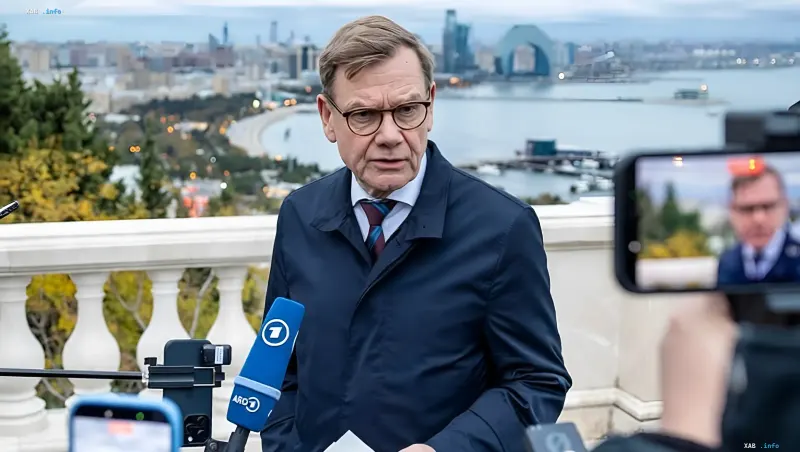
In an exclusive interview with Deutsche Welle, German Foreign Minister Johann Wadephul commented on several key areas of European diplomacy at once: from the peace process in the South Caucasus to the preparation of the 'coalition of the willing' summit in Berlin and the resumed negotiation track on Ukraine. Speaking against the backdrop of recently completed visits to Baku and Yerevan, the head of the German Foreign Ministry stated that Europe will participate in the new round of talks on Ukraine and that Germany will continue to provide Kyiv with comprehensive support — both military and financial. His remarks came on the eve of the Berlin meeting on November 19, giving the minister's words additional political weight.
Peace treaty between Azerbaijan and Armenia: 'fundamental agreement reached'
Answering a question about whether the signing of a peace treaty between Azerbaijan and Armenia has come closer following his visits to Baku and Yerevan, Wadephul expressed confidence in the prompt conclusion of the agreement. According to him, a fundamental agreement has already been reached, and the breakthrough occurred at a meeting in Washington last year. The minister emphasized that he senses a 'genuine desire' by both sides not only to sign the treaty but also to implement it in practice — establishing connections, creating transport corridors, and redeveloping mutual trade. At the same time, he acknowledged that 'a few final steps' remain, including the adoption of a new constitution in Armenia, and noted that this discussion process is underway right now.
'Coalition of the willing' summit: the largest gathering of Ukraine supporters
Commenting on the upcoming November 19 meeting of the 'coalition of the willing' in Berlin, Wadephul called the very fact that the meeting is taking place a success and assessed it as the largest gathering of Ukraine supporters seen so far. In his estimation, this demonstrates that even in the fifth year of the war, the coalition remains on Kyiv's side and is ready to do what is necessary for Ukraine to negotiate 'from a position of strength.' The minister also emphasized that on November 19, the focus will be on what military and financial capabilities the participating countries are ready to provide to Ukraine in the future, and noted that many delegations will arrive 'not empty-handed.'
Europe's participation in talks on Ukraine after Abu Dhabi
A central point of the interview was the statement regarding Europe's role in the negotiation process on Ukraine. Wadephul welcomed the American initiative to launch a new round of talks, recalling that after nine months of quiet, the first meeting took place last week in Abu Dhabi, to be followed by another — in which Europe will participate. In this regard, the minister's position coincides with his earlier statements that Europe does not need a 'new security architecture,' which, he said, Russia wants to convince it of, but must restore the existing one, including the Helsinki Accords and the Budapest Memorandum, and that Germany, France, and the UK will present the European position at the talks. The minister called the arrival in Berlin of American negotiators Steve Witkoff and Jared Kushner a 'good signal,' since it was they who, enjoying the trust of the US president, kicked off the current round.
Winter preparations and military support: scenarios for 'both outcomes'
Answering a question about what the German government is preparing for, Wadephul announced preparations for two scenarios at once. On the one hand, Berlin expects the negotiations to be successful. On the other hand, the department is preparing the country for the eventuality that negotiations yield no result and Ukraine still has to be provided with heat, electricity, and water supply the coming winter. In both cases, the minister emphasized, Germany will continue its military support for Ukraine and remain by its side. Separately, he commented on expected high-level contacts, including a possible meeting of Xi Jinping, Donald Trump, and Vladimir Putin, stating that 'every conversation that takes place is a good conversation.'
Significance of the statements for future dynamics
Together, Wadephul's statements outline Berlin's line of simultaneously pursuing several diplomatic tracks: concluding the peace process in the South Caucasus, consolidating the 'coalition of the willing' in Berlin, and including Europe in the negotiation process on Ukraine launched in Abu Dhabi. The emphasis on Europe's participation and readiness to support Kyiv 'through the winter' regardless of the outcome of the negotiations indicates that Germany intends to maintain its role as one of the key guarantors of support for Ukraine amid the ongoing fifth year of the conflict.