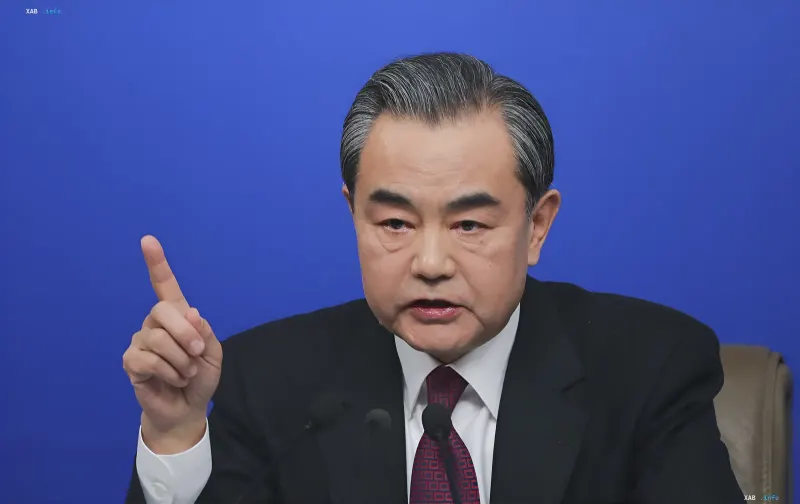
During a joint briefing with his Bulgarian counterpart, Velislava Petrova-Chamova, in Sofia, Chinese Foreign Minister Wang Yi reiterated his call for the parties involved in the Russia-Ukraine conflict to resume dialogue, build trust, and make mutual concessions. According to him, these three elements — dialogue, trust, and compromise — are the foundation for establishing a "lasting peace." The statement was made amid ongoing hostilities and was broadcast through the Chinese Ministry of Foreign Affairs, RBC-Ukraine reports.
"Ukrainian Crisis" in Chinese Terminology
Wang Yi, as is standard in Beijing's official rhetoric, did not use the terms "war" or "invasion," but referred to the "Ukrainian crisis" — the official name for the conflict in the PRC. "From the 'Ukrainian crisis' to conflicts in the Middle East, resolving differences requires trust, and to strengthen it, we need dialogue," the Chinese diplomat stated. In doing so, Beijing once again combined two major global flashpoints in one discourse, emphasizing that the solution to both problems is based on a single mechanism — restoring trust between the parties.
China as a "Responsible Major Power"
Wang Yi placed a specific emphasis on the role of the PRC in global security. He stated that China, "as a responsible major power, is constantly making efforts for peace" and "will always consistently stand on the right side of history, fulfill its international obligations, and play a proper role in eliminating the trust deficit and resolving crises and conflicts." By his assessment, the greatest problem in the modern world is precisely the lack of trust, which he called the "cornerstone of peace." During meetings with Bulgarian colleagues, according to the Chinese Foreign Ministry, the Russian invasion of Ukraine and the regional security situation were also discussed.
Broader Diplomatic Context
Wang Yi's address in Sofia fits into a broader picture of international negotiations surrounding the Ukrainian conflict. Previously, Ukrainian President Volodymyr Zelensky publicly commented on a possible conversation between the leaders of the US, China, and Russia without Kyiv's participation, stating that "the Kremlin leader's emergence from isolation has already begun." In parallel, according to available data, the United States seeks to conclude a new nuclear weapons agreement involving Russia and China, and negotiations in this direction are ongoing. Wang Yi's statement in Bulgaria can be viewed as part of China's diplomatic strategy aimed at solidifying Beijing's role as a mediator and guarantor of the "world order" in conditions of multipolarity.
Technological Aspect of the Conflict
Against the backdrop of diplomatic statements about "dialogue and trust," the technological dimension of the conflict remains. It was previously reported that the Chinese company Shenzhen Xingkai Technology would supply Russia with mesh modems for drones — devices that allow UAVs to maintain communication and penetrate deep into Ukrainian territory during attacks. This fact underscores the gap between the rhetoric of peaceful settlement and the actual flows of technology supporting the military infrastructure of one of the parties to the conflict.