Ukrainian grocery retail is undergoing a fundamental transformation. Over the last six years, the industry has shifted its development vector: the era of giant hypermarkets has come to an end, giving way to compact formats. 'Neighborhood stores' and discounters have become the main growth drivers, adapting to new realities and changing consumer behavior.
Explosive growth in the number of outlets
Statistics from recent years demonstrate impressive dynamics. If 525 new FMCG retail outlets were opened in the country in 2022, by 2025 this figure had risen to 902. In quantitative terms, Ukrainian grocery retail increased by 41.8% during this period. However, this growth is driven not by the expansion of floor space, but by the density of coverage by small-format networks.
According to Igor Gughli, co-founder of the industry portal All Retail, a shortage of large formats was felt even before the start of the full-scale war. Four years of hostilities only exacerbated the situation, making logistics and product availability critically important factors for business survival.
Who is surviving in the large-format segment?
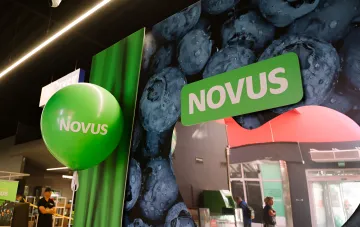
Today, the large-format market is effectively monopolized by two players: 'Silpo' and Novus. These are the only operators continuing to develop classic supermarkets and hypermarkets. Other market participants have redirected resources toward more practical and agile formats.
The expansion of major chains now occurs primarily through smaller-format brands. Thus, Fozzy Group is actively developing the 'Fora' and 'Trash' networks, while Novus is betting on the 'Mi Market' format. The strategy is to be closer to the customer, offering convenience and speed.
Mergers and acquisitions: the Varus example
A striking example of adaptation to new conditions was the deal by the Terwin management group. The acquisition of the 'Kolo' chain allowed the Varus holding to significantly strengthen its position specifically in the convenience retail segment (everyday needs stores). The deal, covering 254 retail outlets, particularly strengthened the company's presence in Kyiv, where competition for the customer is highest.
The victory of regional players
Despite the aggressive expansion of federal brands, regional networks are not only surviving but also holding strong positions. 'Fayno Market' and 'Blyzhenko' have become examples of successful work in their niches. Their advantage lies in a deep understanding of local demand and proximity to the end consumer.
Andrey Zhuk, head of the Association of Retailers of Ukraine, notes that heightened competition forces businesses to operate more efficiently. There is no mass displacement of small players, as their 'barometer' of demand and geographical proximity to customers remain an indisputable competitive advantage.
Thus, the war and the transformation of consumer habits have made the 'neighborhood store' format the main beneficiary of recent years. The market has become more fragmented, but also more responsive to the needs of the population.